Making the Old Croton Aqueduct Trail Welcoming to Pedestrians and Cyclists

Mayor Brown, Lesley Walter, and Dan Convissor (of Livable Tarrytowns) on the OCA on October 5.

On the morning of Saturday, October 5, 2024, Tarrytown Mayor Karen Brown joined Lesley Walter, President of Friends of The Old Croton Aqueduct, Robert Lee, Assistant Manager of Old Croton Aqueduct State Historic Park, and members of Livable Tarrytowns’ Old Croton Aqueduct (OCA) working group, for a walk along the OCA trail. The trail is important for many reasons. Chief among them is that it is a well-used route for students and their families walking to and from the Washington Irving School and the John Paulding, middle school, and high school campus.

Beginning at East Franklin and Broadway in Tarrytown, the group headed northward to Bedford Road in Sleepy Hollow. Along the way, the group stopped at each street crossing to evaluate it and consider measures to improve pedestrian and bicycle safety. Below we outline Livable Tarrytowns’ suggestions for improvements.

The first stop was Elizabeth Street. The intersection needs three improvements:

  1. ADA conforming curb cuts on both sides of Elizabeth Street;
  2. a painted and raised crosswalk; and 
  3. a “daylighting” of the northside of the crossing area, with a 15-foot clearance on either side.
Elizabeth Street, looking northward to the OCA.

The group then proceeded to Neperan Road, a two-way street that sees a good deal of traffic. Of particular concern is the high speed at which many vehicles come down the hill as they head toward Broadway. This is concerning not only for people traveling along the OCA trail, but also individuals coming to and from nearby Neperan Park, many of whom cross Neperan Road. As such, a broader set of interventions are needed. They include:

  1. a 3-way stop sign at Altamont and Neperan to force vehicles to slow down at what is a blind curve;
  2. a painted crosswalk that connects the curb cut at Altamont and Neperan to the entrance at Neperan Park;
  3. the installation of an ADA curb ramp at the access point of Neperan Park;
  4. a painted crosswalk with signage on Neperhan at Grove Street;
  5. a painted crosswalk with signage at the OCA crossing and a curb extension or bump out on the north side; and 
  6. the removal of the two parking spots immediately adjacent to the OCA trail entrance on the north side of Neperan.

Hamilton Place was the next stop. Participants in the group identified three measures that are needed:

  1. a painted crosswalk, along with signage, connecting the two sides of the OCA trail at Hamilton; 
  2. an ADA-conforming curb cut on the southside of Hamilton; and
  3. the prohibition of parking on the southside of Hamilton within 15 feet of the OCA trail (see the red vehicle in the photo below). 
Hamilton Place, looking southward.

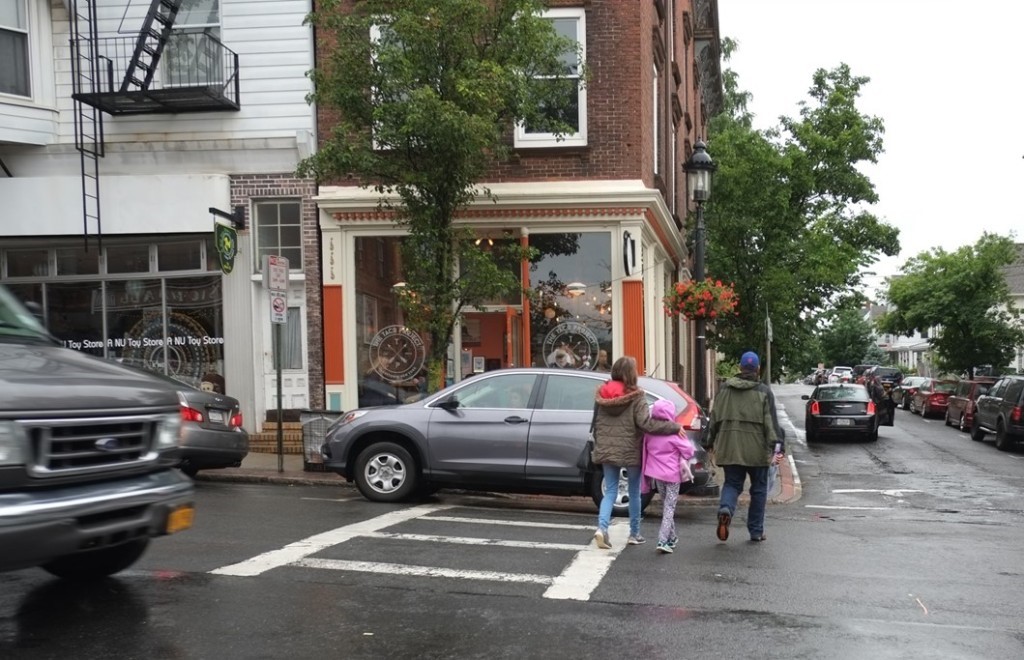
After Hamilton Place, the group continued northward to McKeel Avenue, a street of major concern for area residents. It was near the OCA crossing where a vehicle struck and killed Mr. Anthony Napoli on August 4, 2022. A crosswalk, signage, and ADA curb cuts are already in place on McKeel (see photo below). Nonetheless, further improvements are needed–not least because of the width of the road and the fact that pedestrians must cross two lanes of traffic. Given these factors, curb extensions or bump outs are needed on either side of the crosswalk. Also necessary are measures to slow down vehicular traffic, particularly at times when the sun makes it difficult for drivers to see the road. Possible measures include: a narrowing of the road, chicanes, and/or speed bumps.

McKeel Avenue at the OCA.

Cobb Lane, a very steep and narrow street, was the next stop. Despite many pedestrians using the street to access the OCA, the various schools on the TUFSD campus, Patriots Park, and other points on Broadway, there is no sidewalk or barrier to protect them. Here are two changes that could improve matters:

  1. the painting of a 5-foot wide “sidewalk” (with some sort of raised edge) along the north side of Cobb Lane from the OCA to Broadway; and
  2. making Cobb Lane from the OCA to Broadway a one-way street.
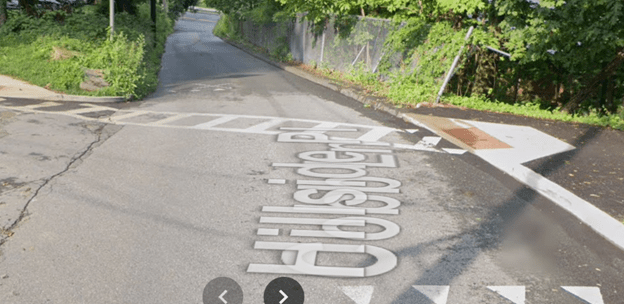
Cobb Lane at the OCA, looking toward Broadway.

Finally, the group went through the campus of Sleepy Hollow Middle School and Sleepy Hollow High School. Because part of the school building sits atop the actual aqueduct, the trail goes around the east side of the building. Then, north of the building, because several property owners on Hudson Terrace have blocked the OCA’s right of way up to Bedford Road (Route 448), trail users must travel through a parking lot. Resolving these difficulties requires short term and long term steps.

Short term:
  1. Wayfinding signs at appropriate locations on the school campus;
  2. a dedicated walkway on the east side of high school parking lot adjacent to the baseball and softball fields;
  3. unlocking the  gate at Bedford Road on the east side of parking lot to allow walkers and bikers to access the trail system connecting the OCA and Tarrytown Lakes;
  4. an adjustment of the driveway gate so there is a five-foot-wide passage for bikes, adaptive bikes, and wheelchairs; and
The current driveway gate, as seen above, does not allow for passage of bicycles and wheelchairs.

5. the relocation of the map sign from the school side of Bedford Road (see photo below) to the trail side.
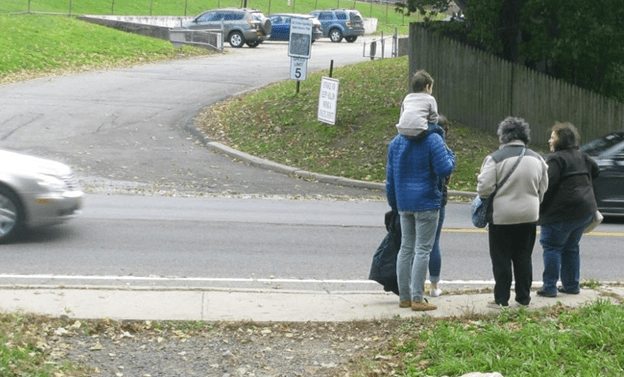
Currently, there is no map on the north side of Bedford Road to indicate to people heading southward where to go to continue on the OCA trail.
Long term:
  1. A raised crosswalk on Bedford Road, with signage, at the north end of the high school parking lot; and
  2. reclamation of the OCA property behind Hudson Terrace.

Livable Tarrytowns will push for these changes and more by working with officials in both Sleepy Hollow and Tarrytown as well as with the Public Schools of the Tarrytowns. If you have suggestions for additional improvements, please reach out!

Walking on the OCA trail on October 5, 2024.

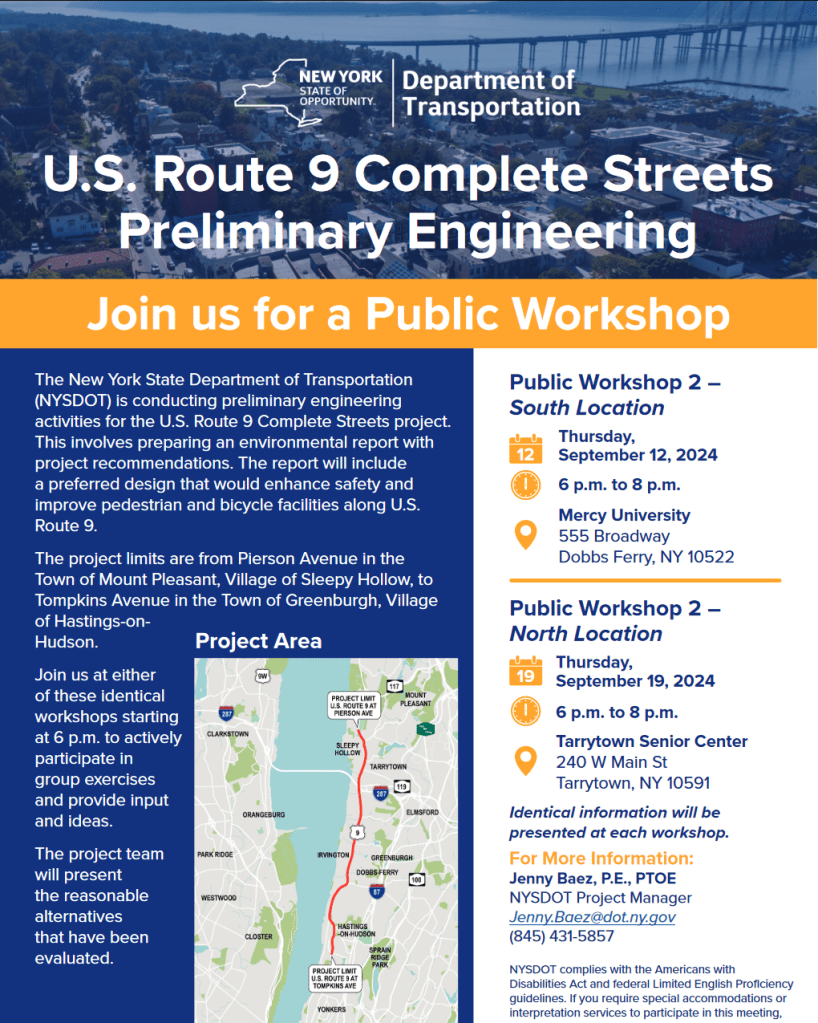
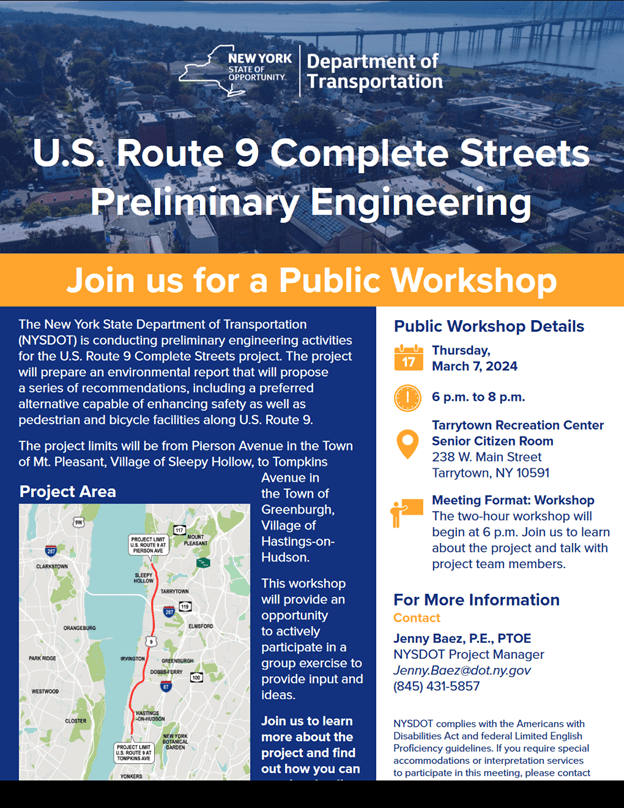
Important Public Workshop on/Importante Taller Público sobre Route 9

The Route 9 public feedback meeting is THIS THURSDAY 9/19 at 6pm, at the Tarrytown Senior Center (240 West Main St)! Please join us there to see the proposed designs and give your feedback – and then join us at Beekman Ale House for the afterparty!

Thursday’s meeting is the second of two; the first one was held last week (September 12) in Irvington. You can learn about what transpired at that meeting here.

Our friends at Bike Tarrytown have prepared an “update” on what to expect at this Thursday’s meeting in Tarrytown, while suggesting important points for pedestrian and cycling safety advocates to make in response the current proposal of the NY Department of Transportation (DOT) .

We hope to see lots of Sleepy Hollow and Tarrytown folks at Thursday’s meeting! A strong turnout is vital for ensuring that DOT officials know that there is broad and deep support for a Route 9 that is safe and enjoyable for walking and biking!

Click on the posters below–in English and Spanish–to learn more.

Recent Victories to Celebrate, More Work to Do!

Blocked crosswalks on Main Street and John Street, Tarrytown, June 20, 2024.

Scenes such as this recent one showing vehicles parked in crosswalks in downtown Tarrytown threaten pedestrians. Frustrating and all too common, they serve to remind us of one of the many reasons the work of Livable Tarrytowns is so necessary.

But we also need to remember and celebrate what we (along with our allies) have accomplished in the last few months—not least to sustain ourselves!

On May 29, the Sleepy Hollow Board of Trustees approved a “Sustainable Complete Streets Policy” that contains clear benchmarks that the Village needs to achieve each year. Originally drafted by Sustainable Sleepy Hollow, the policy requires the Village to “carry out a system of implementation, to include surveying roadways and intersections, identifying opportunities for improvements, ranking streets and roadways identified for enhancements, installing pilot or demonstration projects, evaluating performance of the pilot or demonstration projects, and permanently installing these projects.”

Different projects have distinct point values assigned to them. Installing a marked crosswalk with signage or putting in a speed hump, for example, is worth two points, while a roundabout (a major undertaking) is worth twenty. New sidewalk planters or planters at curb extensions get one point, while the installation of bioswales or raingardens at tree pits within curb extensions receive seven points. The Village must attain a minimum of 25 points annually.

And Sleepy Hollow is already making progress.

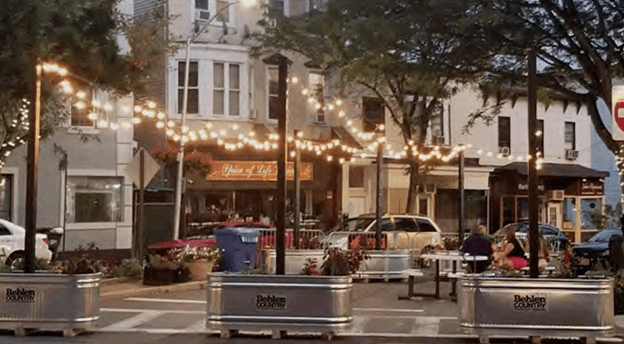
Pedestrian plaza, looking southward from Beekman Avenue at Cortlandt Street.
Credit: Village of Sleepy Hollow.

Currently, the Sleepy Hollow Board of Trustees is conducting an analysis of the temporary and highly successful pedestrian plaza on Cortlandt Street at Beekman Avenue with an eye toward improving it and making it permanent. The Village has grant money that it has won and will apply to the plaza.

In addition, in response to emails and letters from residents and parents of schoolchildren, the Village has painted curb extensions (or “bump-outs”) around crosswalks on Beekman Avenue and Pocantico Street. Soon—to prevent scenes such as the one shown above in Tarrytown—the Village of Sleepy Hollow will install physical barriers to deter vehicles from parking in the bump-out areas.

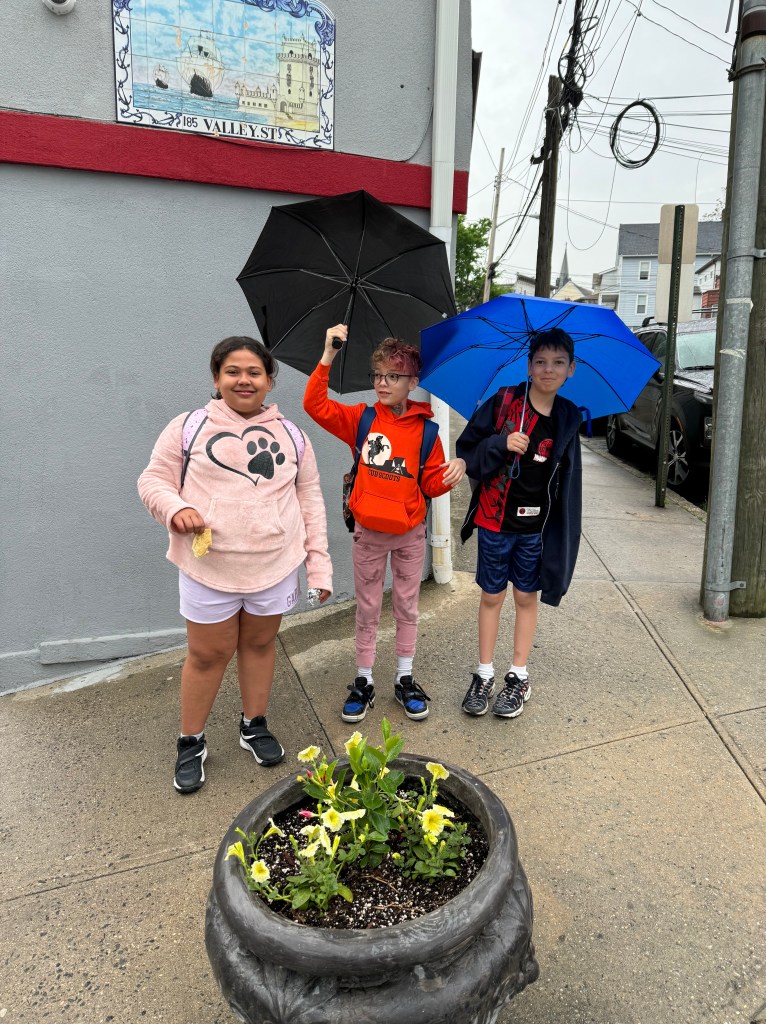
School walkers at Valley Street, May 8, 2024.

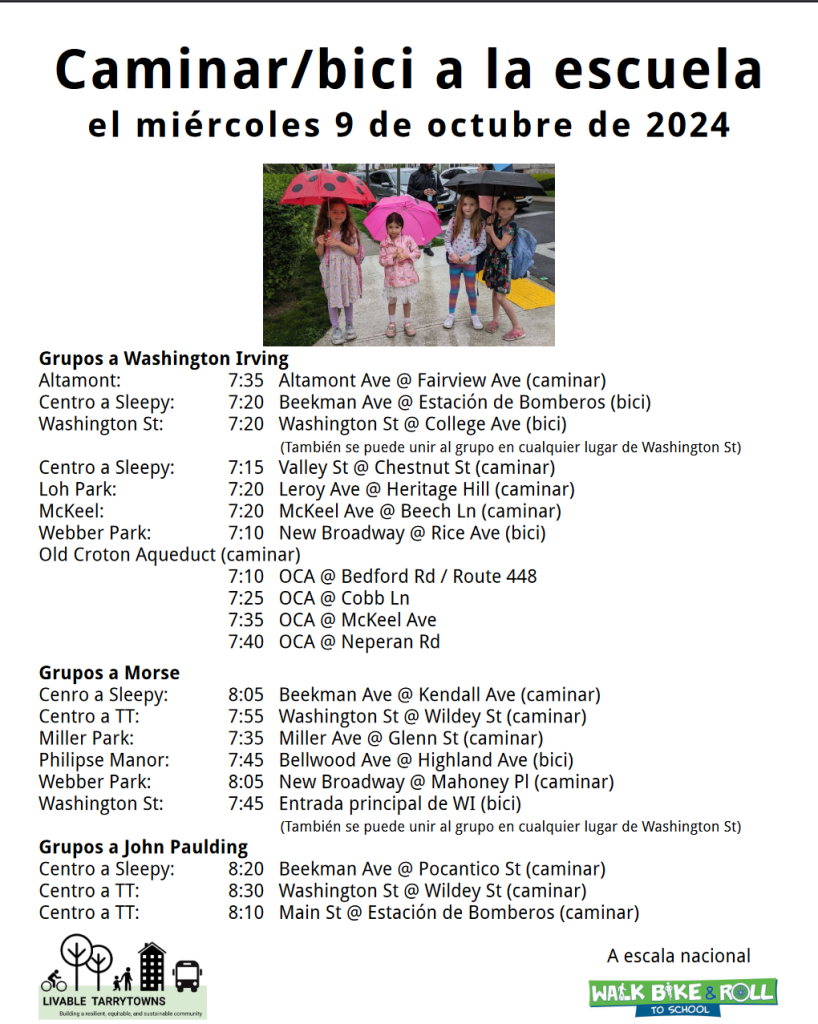
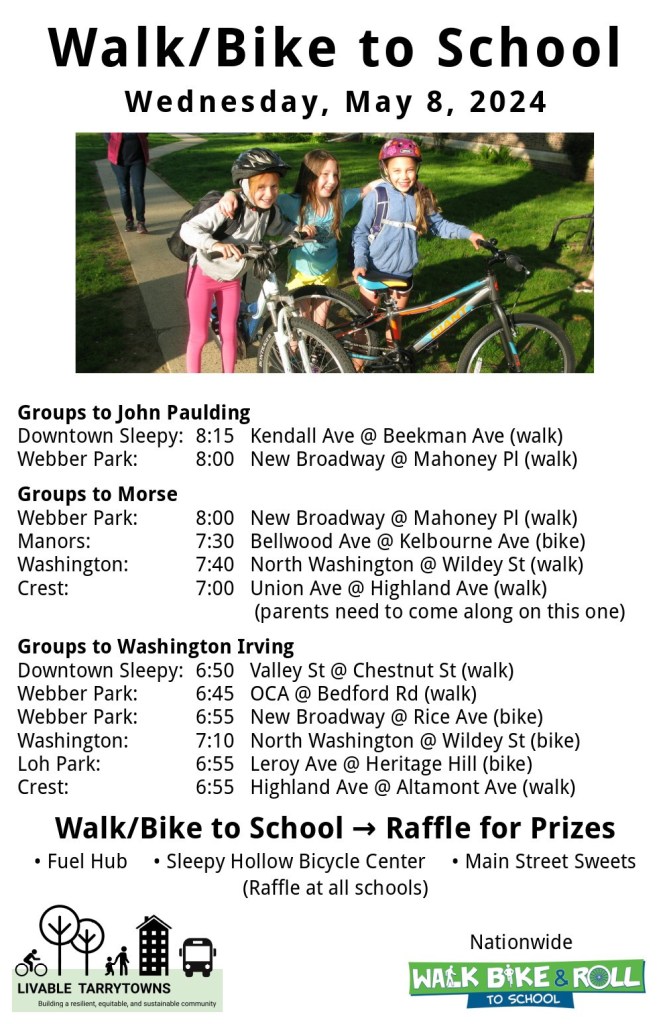
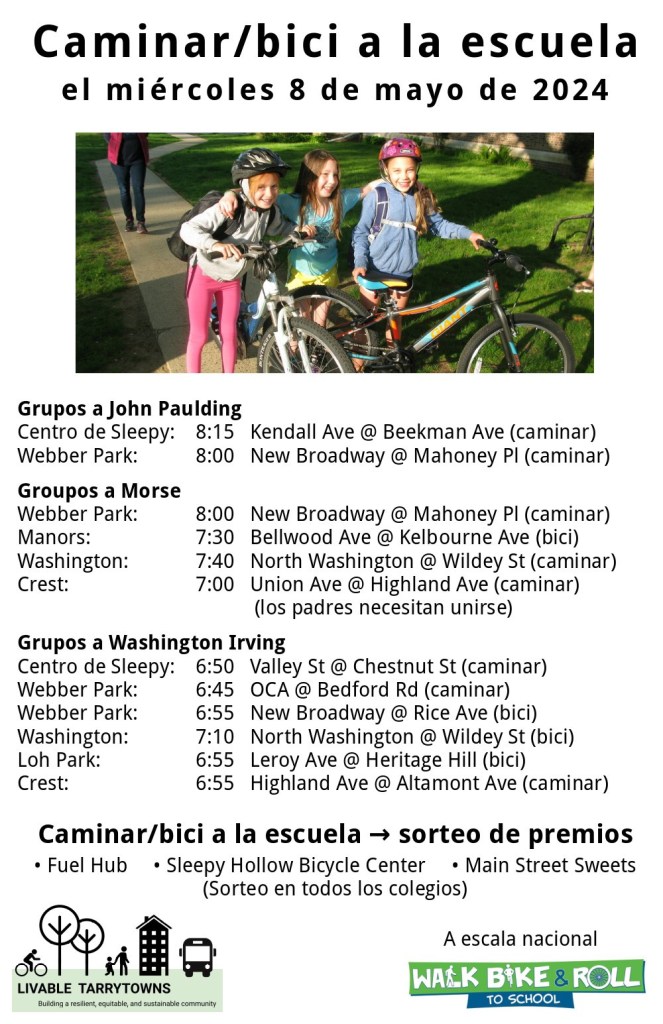
The redesign of the crosswalks near the Morse School comes on the heels of a highly successful Walk/Bike to School Day on May 8—this despite it being a rainy day. Organized by Livable Tarrytowns, the event saw scores of children walking and biking in groups, along with parents and members of the board of trustees from both villages, to the elementary schools. (We are planning another walk and bike day for October 9. Dr. Raymond Sanchez, TUFSD superintendent, will be among the participants!).

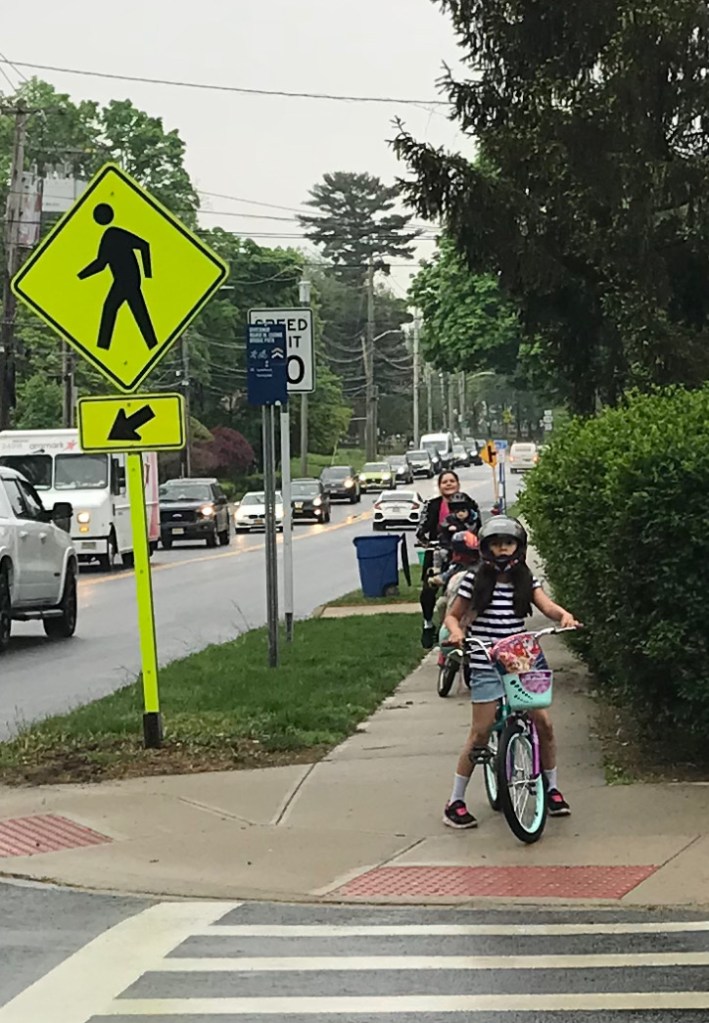
Biking on Broadway to the Morse School. (More photos below.)

Also in relation to the TUFSD, the New York State Department of Transportation (DOT) has agreed to make a positive change in proximity of the high school/middle school/John Paulding campus. In a May 6, 2024, letter to the Village of Sleepy Hollow, the DOT approved a “School Safety Zone” and a lowering of the speed limit to 20 miles per hour on Bedford Road (Route 448) between Webber Avenue and Broadway (Route 9).

In the same letter, the DOT approved a speed limit reduction to 25 miles per on Broadway from Bedford Road to College Avenue, but refused to lower it to 20 miles under the dubious logic that there is a signalized crosswalk at Depeyster (and Broadway). Overcoming the DOT’s obstinance to the extension of the “School Safety Zone” along Broadway requires that the New York State legislature pass a “home rule resolution.” Livable Tarrytowns will work with allies to bring about the passage of such a resolution in the next legislative session (which begins in January 2025).

Finally, in mid-May, Livable Tarrytowns submitted a letter to the DOT signed by more than 240 residents of Sleepy Hollow and Tarrytown. The letter called upon the agency to install a median refuge on Broadway at McKeel along with bump-outs at the crosswalks. At the urging of members of Livable Tarrytowns, the Board of Trustees of Tarrytown passed a strong resolution in support.

On June 13, the DOT responded by letter to Livable Tarrytowns. The good news is that the DOT intends to narrow the intersection by pushing the curb on the west side of Broadway into the intersection. On the east side of Broadway at McKeel, the DOT is currently planning to install “bump out” extensions at the crosswalks. Unfortunately, however, the DOT has decided against installing a median refuge.

That said, the letter noted, “The Route 9 Complete Street Project, currently in the preliminary design phase, is evaluating the entire corridor through Tarrytown to determine if median refuge islands are appropriate and feasible.” In other words, more far-reaching changes are under consideration.

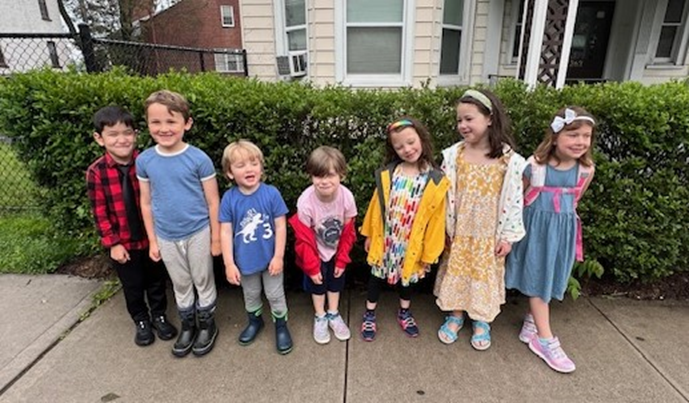
Sleepy Hollow Manor bikers outside the Morse School.
Walkers from the Crest in Tarrytown to the Washington Irving and the Morse schools.
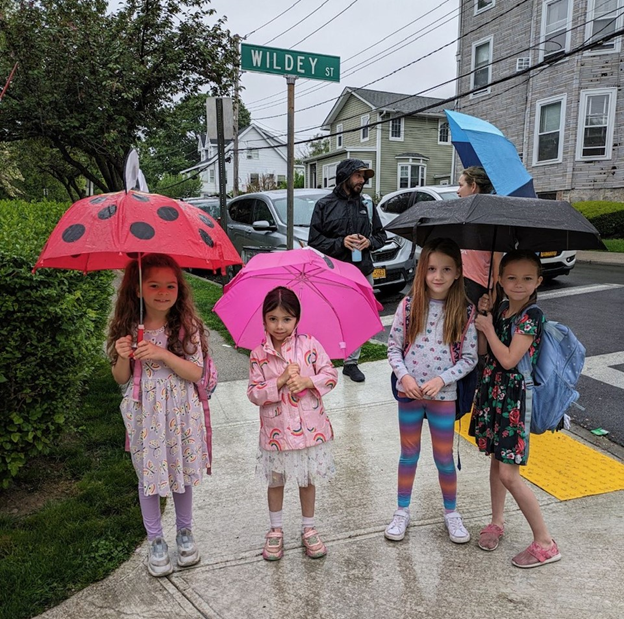
Walkers at Wildey Street and North Washington.
Webber Park (Sleepy Hollow) walkers to the John Paulding.
Walkers on Main Street heading to the John Paulding and Morse schools.


Route 9 Complete Streets Workshop

Please join us and make your voice heard!

Thursday, March 7, 2024
6:00pm to 8:00pm

Tarrytown Senior Center
240 W. Main Street, Tarrytown

To learn more about the workshop, click on the image of the flyer below.


And here is document of “talking points” for supporters of Livable Tarrytowns who attend the workshop. (If you click on the image, it will take you to the full-sized document.)

Pedestrian Safety Survey Results

From October 15 through December 15, 2023, Livable Tarrytowns and Bike Tarrytown conducted a pedestrian safety survey. Advertised by way of flyers posted around Sleepy Hollow and Tarrytown, email, and various social media channels, the survey attracted close to 600 responses.

Respondents, many of whom wrote about more than one particular site, raised a total of 785 concerns about unsafe walking locations in the two villages. Not surprisingly, many wrote about the same crossing point, intersection, or street. Still, as shown on the map we generated, survey respondents highlighted over 100 problem areas. In this way, they made clear that problems with pedestrian safety in Sleepy Hollow-Tarrytown are not limited to a small number of intersections or thoroughfares, but are widespread. 

“My friends and I came to Tarrytown as tourists for the first time, and the first thing we noticed was how cars don’t yield to pedestrians.”

Pedestrian Safety Survey participant

Numerous people expressed fear about traversing the two villages. As one individual wrote in regard to Central Avenue and Broadway in Tarrytown, “Crossing the street with little kids is terrifying and I see it on the faces of other parents too. Like they don’t really know if they’ll be seen and then have to sprint.” Not surprisingly, the Broadway/Route 9 corridor received the highest number of responses by far. And, as shown in the map generated from the results, a small number of areas along that corridor received the lion’s share of attention. (Many thanks to Neil Curri, a cartographer and GIS Lab Manager at Vassar College, for donating his time and skilled labor and producing the map.)

“Crossing the street with little kids is terrifying and I see it on the faces of other parents too. Like they don’t really know if they’ll be seen and then have to sprint.”

Survey respondent re: Central Avenue and Broadway in Tarrytown

There are two areas of greatest concern along Broadway.

Partial view from Broadway of the intersection. Bedford Road is to the right, New Broadway in straight ahead, and Route 9, heading northward bends to the left. Source: Screen shot of video produced by Bike Tarrytown.

The first is the five-way intersection (of sorts) where Bedford Road, Beekman Avenue, Hudson Terrace, and New Broadway all converge with Broadway/Route 9 in Sleepy Hollow, a highly dangerous area of longstanding concern among local residents. Respondents suggested various traffic-calming “fixes” to this highly dangerous area, ones ranging from raised crosswalks to pedestrian-activated strobe lights. Over the years, Bike Tarrytown has also made many recommendations, including curb extensions, for the area.

The second is where McKeel Avenue and Broadway converge. As reported in our previous blog post, Bike Tarrytown and Livable Tarrytowns have come up with concrete proposals–short-term and long-term–to transform the intersection, one that has proven deadly for pedestrians on two occasions since August 2022.

While there are many other areas in need of attention, we briefly mention four more that survey respondents highlighted.

  1. Neperan Avenue and the Old Croton Aqueduct Trail (Tarrytown): Vehicles parked immediately adjacent to where the trail crosses Neperan on the north side of the street block the line of sight. There are also no markings indicating that where the OCA and Neperan intersect is a crossing location for pedestrians and cyclists. A curb extension or “pinchpoint” on the north side of Neperan, a raised crosswalk and signage–among other changes–are desperately needed.
  2. Bedford Road, Webber Avenue, and the Old Croton Aqueduct  (Sleepy Hollow): This is a key school route for students and their families. It is also where the aqueduct trail enters the TUFSD campus. Due to the lack of a crosswalk, the speed of cars coming down the hill, and the low visibility due to curves, this is a hazardous crossing location for pedestrians.
  3. Depot Plaza and West Main Street at Railroad Avenue (Tarrytown): Due to many people walking to and from the train station, this is a heavily pedestrianized area. Of high concern are the two crosswalks that connect the Metro North station and Tarrytown Village Hall. Drivers frequently speed and ignore pedestrians within the crosswalks or block the crosswalks (particularly on the station side of the street) with their vehicles. Some simple engineering–curb extensions and raised crosswalks, for example–could greatly enhance pedestrian safety in the area. Also unsafe is the west (river) side of the station, at the bottom of the H-bridge, where West Main and Railroad Avenue meet. An area of frequent speeding, there is a need for wider sidewalks, additional crosswalks, and traffic calming interventions in the general area.
  4. Franklin Street and Broadway (Tarrytown): Students and their families walking to and from the Washington Irving Intermediate School have to cross two busy streets that are heavily trafficked. According to reports received by Livable Tarrytowns, there have been a lot of “close calls” at this intersection and it is in need of urgent attention and remediation.

“[The villages] are not safe for anyone: sidewalks are terrible, a hazard, especially to [those who are] impaired, disabled, kids, and seniors.”

“It’s truly shameful how poor pedestrian infrastructure is on the main route for train commuters.”

Respondents to the Pedestrian Safety Survey

How to view the map

The map is a compilation of all the responses to the survey that we received. If you click on the image below, it will bring you to the interactive map.

It is a “heat map.” A heat map shows the relative number of responses received by locations. In this case, yellow indicates the highest number of responses in an area, followed by red, and then purple (light purple being a relatively low number).

Viewers can control the size of the map via the “zoom” features (the “+” and “-” signs in the upper right corner.

A yellow dot indicates a location that at least one survey respondent raised concerns about. If you click on one of them, a box such as that to the right will emerge. In the bottom right corner, it indicates how many respondents wrote about the location (four in the case of Beekman and Pocantico). Viewers can scroll through the various responses using the arrows in the bottom left corner, and thus how survey takers described the problem, their suggestions for improvements, and any other comments.

This is a local road with 30 mph speed limits, not a highway. Why is it designed like a highway?

Survey respondent re: White Plains Road in Tarrytown

Next steps

On Saturday, February 24, 2024, Livable Tarrytowns had a meeting at the Warner Library to present and discuss the results of the survey. Twenty-five residents of Sleepy Hollow and Tarrytown were in attendance.

In the second half of the gathering, attendees organized themselves into three groups to focus on specific problem areas. Group members brainstormed about the changes they would like to see and how to bring them about–by working with local and state officials as well as with residents and non-governmental entities in the area. These groups are now standing bodies under the umbrella of Livable Tarrytowns, each of which has a particular focus.

The three groups are:

The School Safety Zone Working Group: Its focus is the slowing down of traffic in the vicinity of all schools in the Tarrytowns and the development of safe walking and cycling routes to and from those schools–both of which require changes in the streetscape and the associated infrastructure.

The Broadway for All Working Group: While the entire Broadway corridor in Sleepy Hollow and Tarrytown is the group’s concern, its initial focus is on Broadway and McKeel. Its broader goal is to transform Broadway so that it a safe and enjoyable thoroughfare for pedestrians and bicyclists alike.

The Old Croton Aqueduct Working Group: This group concentrates on where the aqueduct trail intersects streets to ensure that crossing locations are safe for pedestrians. Its initial focus is on where the trail crosses Neperan Road in Tarrytown and Bedford Road in Sleepy Hollow.

If you would like to join a working group (or start one of your own), please send an email to livabletarrytowns@gmail.com.

In the coming weeks and months, Livable Tarrytowns will share the survey findings with officials in the two villages and the public school district. The survey is one tool among many that we need to deploy to win support for far-reaching changes needed to make the villages’ thoroughfares–and public space more broadly–safe and welcoming to all, particularly for the most vulnerable among those who live and work here.

Postscript: River Journal ran an article about the survey and the findings. You can find the article here.


A Broadway for All, Starting with the McKeel Avenue Intersection

Nelida Distante

A recent four-week span has tragically exposed, yet again, how dangerous Broadway is for pedestrians in Sleepy Hollow-Tarrytown. It also painfully highlights the urgency of transforming the principal thoroughfare that joins the twin villages for the well-being of our families, friends, and neighbors.

Patrick Kennedy

On the evening of Wednesday, November 29, 2023, two drivers and their vehicles struck Nel­ida Dis­tante as she crossed Broadway at McKeel Avenue, taking the life of the 82-year-old Tarrytown resident.

Less than one month later, on Tuesday, December 26, at a little before 2 p.m., a driver hit and killed Patrick Kennedy, 79, also of Tarrytown, while he crossed Broadway at Route 119.

In both instances, the victims were in marked crosswalks when they were struck.

The untimely deaths have renewed and intensified efforts to make Broadway safe for all—pedestrians, bicyclists and drivers.

Concerned residents, many of them involved with Livable Tarrytowns and Bike Tarrytown, met twice in December. They brainstormed and discussed changes that they would like to see to the design of what Anne White, co-head of Sustainable Sleepy Hollow and a meeting participant, has referred to as the “Main Street” of the two villages. The initial focus has been on the area of Broadway and McKeel given that it has been the site of two vehicle-induced fatalities of pedestrians since August 2022. (On August 4, 2022, a driver and his pickup truck killed Mr. Anthony Napoli, 70, on McKeel, between the Croton Aqueduct and Broadway.)

Out of work already done in relation to the Route 9 Active Transportation Project, ideas generated by the discussions, and the design efforts of Bike Tarrytown, two proposals have emerged for what a “good” Broadway and McKeel would look like.

Short-term/pilot proposal for Broadway and McKeel Avenue, January 2024.

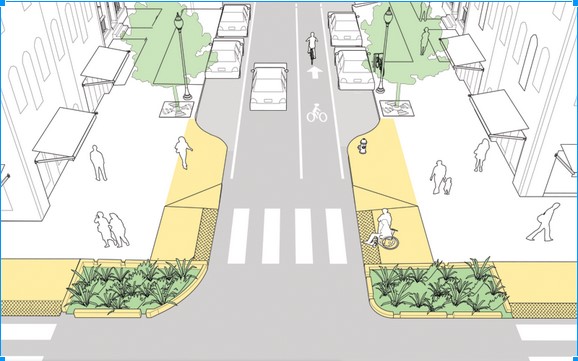
Illustration of curb extensions. Source: National Association of City Transportation Officials (NACTO).

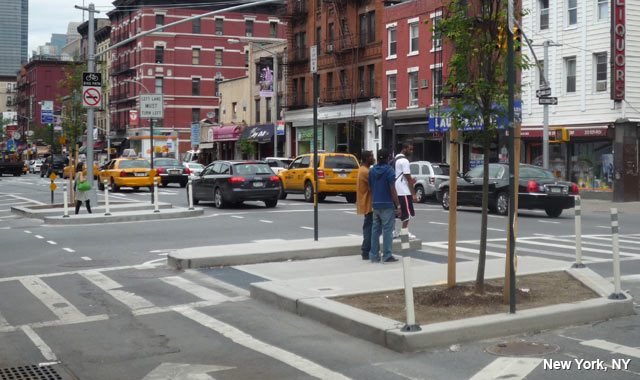
The first proposal (above) is for a pilot project to address safety issues in the short term. It would entail the creation of medians (indicated in purple) in the middle of Broadway via temporary barriers so that pedestrians have a refuge and that they don’t have to cross multiple lanes of traffic. It would also include curb extensions that lessen the distance that pedestrians must traverse in crossing a street. These modifications would have the added benefit of “daylighting” the crosswalks (with two crosswalks added at Dixon Street), thus enhancing pedestrian visibility and welfare.

Pedestrian refuge, New York City.

McKeel Avenue itself would also see changes in the form of a median refuge and a narrowing of the road in proximity to Broadway. The redesign would increase the likelihood that drivers travel at safe speeds. Had these alterations been implemented prior to August 2022, they might very well have saved Mr. Napoli’s life.

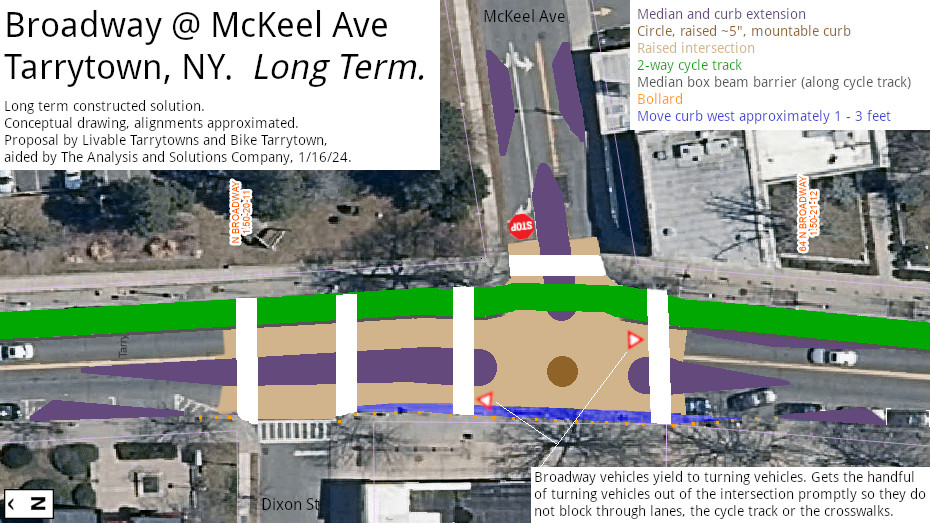
The second proposal is for a “permanent” or long-term transformation. As illustrated by the drawing below, the changes would include raising the intersection—from Dixon Street to McKeel Avenue—along Broadway and elevating the crosswalk that traverses McKeel as well. It would also involve installing a two-way, protected bicycle track along the east side of Broadway.

Proposal for long-term changes at Broadway and McKeel Avenue, January 2024.

In regard to the proposed changes on McKeel Avenue, the Village of Tarrytown has full authority to make them as it controls the road. Making changes on Broadway, however, is a different matter as the New York State Department of Transportation (NYSDOT) is in charge of the thoroughfare.

If past practice is any indication, it is doubtful that New York’s DOT will be keen on changes to Broadway anywhere near as ambitious as the ones proposed above. The state agency has long been resistant to adopting “best practices” for pedestrian safety in a broad sense, focusing instead on maximizing the efficiency of vehicular traffic flow. However, the DOT has been in conversation in recent weeks with the Village of Tarrytown regarding safety and the Broadway-McKeel Avenue intersection. At the same time, the DOT has been demonstrating of late an openness to engaging constructively in the redesign of Broadway from Hastings to Sleepy Hollow through its participation in the Route 9 Complete Street Preliminary Engineering project. As such, there are openings for pushing for far-reaching changes.

A street crossing in the Netherlands.

Still, bringing about “A Broadway for All” will undoubtedly require significant pressure from elected officials in both Sleepy Hollow and Tarrytown and residents of the two villages to push the DOT to adopt the types of changes embodied in the drawings above. These changes, inspired by “best practices” in many European countries (see, for example, here), reflect a concern for the well-being of all who use Broadway.

In response to our proposals, some will likely stress the need to be “realistic” in terms of advocating changes to Broadway and McKeel (and the Broadway corridor as a whole). What took place along Broadway between November 29 and December 26, however, demonstrates the need to move beyond the boundaries of what passes for pragmatism, to “think big”–and act accordingly. In other words, we need to create a new reality.

That other countries —and some U.S. municipalities as well–have adopted changes such as the ones we are suggesting here shows what is possible. Only by making far-reaching changes can we make scenes like the one below a remnant of an ugly past rather than painful evidence of an unacceptable present.

Police investigation of killing of a pedestrian by a motor vehicle and its driver on Broadway at Route 119; December 26, 2023. Photo by Kevin Miller.

Two Villages and Public School System Awarded Safe Streets Grant

In October, the villages of Tarrytown and Sleepy Hollow together with the Public Schools of the Tarrytowns were awarded a grant through the federal Safe Streets and Roads for All program. The program is divided into two granting periods, a “planning and demonstration” stage and an “implementation” stage. The first granting period, for planning and demonstration, will begin in January.

According to Tarrytown trustee David Kim, the amount of the grant will enable attracting a top-tier traffic consultant to identify and address problem areas in pedestrian, bicycle, and car traffic safety across the two villages.

The Safe Streets and Roads for all grant, with its particular focus on accessibility to pedestrians and bicyclists, is intended to supplement work being done by the New York State Department of Transportation (NYSDOT) in its Route 9 action plan, especially since the consultant hired for that project, WSP, will likely focus on car traffic issues.

David Kim

“There will be some conflict” between the two projects, Kim acknowledges. But he hopes the Safe Streets and Roads grant can be leveraged to ensure NYSDOT follows through on making Route 9 safely traversable by all, regardless of age, income, or ability.

The planning stage is expected to take one year from January 2024, with re-application and implementation to follow.

–Elizabeth Tucker

Main Street in Irvington, December 2022. Note the safety improvements: curb extensions (or “bumpouts”) and the “daylighting” of crosswalks.

A survey about pedestrian safety in Sleepy Hollow-Tarrytown

Main Street, downtown Tarrytown

Imagine a Sleepy Hollow-Tarrytown where it is safe and enjoyable for children to walk (as well as bike) to local schools, or where the wellbeing of pedestrians is paramount in the downtown areas and in the design of our streets broadly.

It is in this spirt that Livable Tarrytowns, along with Bike Tarrytown, has launched a survey to ask people who live or work in the two villages to share their concerns about unsafe places to walk. Of particular interest are places where people cross streets (both where there are crosswalks or where they are lacking), and places where speeding is frequent. The survey also asks for respondents to offer their ideas to rectify unsafe situations.

The goal of the survey is to gather data that we will share with local officials, and to inform our work to improve pedestrian infrastructure so that walking (and bicycling) is safe and enjoyable, not least for our most vulnerable residents.

In addition to letting people know about the survey via various email lists, we are posting flyers around Sleepy Hollow and Tarrytown that allow people to access it via a QR code (see below).

People can also access the survey via this link.

If you would like to print out and post flyers near where you live or walk, please email us at livabletarrytowns@gmail.com, and we will send you a .pdf of the flyer.

The survey will remain open until December 15, 2023.