A Crucial and Contested Election for Sleepy Hollow’s Trustees

Sleepy Hollow’s Mayoral and Board of Trustees election this year is contested—with the Sleepy Hollow Democrats facing off against the Unite Sleepy Hollow ticket on November 4, 2025. It is an election whose outcome will have long-term implications for the safety of village streets, the availability of affordable housing, and the general well-being of Sleepy Hollow residents.

Of the Sleepy Hollow candidates, Jared Rodriguez and Cory Krall, both on the Democrats’ slate, responded to Livable Tarrytowns’ recent questionnaire on livability and housing issues. Both showed notable areas of agreement on what direction they believe the village should move in. And both proposed interesting ideas that Livable Tarrytowns believes voters should consider as they make their choices this year.

Trustee Rodriguez, who is seeking re-election, and Candidate Krall agreed on three out of the five Sleepy Hollow intersections that they would most like to improve for pedestrians and cyclists: Chestnut/North Washington/Valley, Beekman/Broadway/Bedford/New Broadway, and Pocantico/Broadway. Both Broadway intersections are encompassed within the Route 9 Project that will shortly produce a final design. The trustees elected in November will play a critical role in determining what portions of that design are built and when. They will also impact what the final designs look like.

On our village-controlled streets, Trustee Rodriguez proposed a particularly exciting solution for the frustrating and dangerous Chestnut/North Washington/Valley Street intersections, He calls for “reimagin[ing] [them] and the park here as a public square. We could leverage these improvements to also expand housing opportunities and transform this triangle into another coveted public space for Sleepy Hollow.”

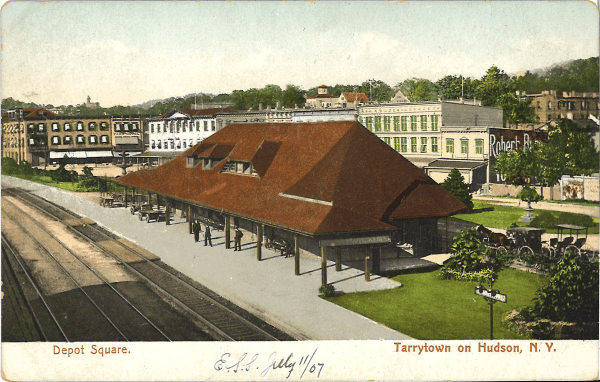
Tarrytown Train Station, 1908

The proposal calls to mind the Central Square plaza at Cortlandt and Beekman that Trustee Rodriguez implemented during his current term. Public squares were a feature of the original streets of Tarrytown-Sleepy Hollow. An example is the original plaza at Tarrytown Station that featured a fountain and spilled into a vibrant commercial and residential area. It’s a reminder that our local representatives have the power to re-envision streetscapes that are currently a hassle and a danger, remaking them into usable and beautiful public spaces that benefit us all.

Tarrytown Train Station, 1907

When asked about why making streets safe for all neighbors is a matter of equity, Candidates Krall and Rodriguez both emphasized that many people who live here simply cannot afford the enormous cost of owning a car. Safe streets matter not only because people should have the choice to walk or bike, but because some people have no choice about doing so.

The trustees elected in Sleepy Hollow will have a lot of leeway to decide whether and how to cooperate with Tarrytown’s trustees to accomplish goals that benefit both villages. Candidates Krall and Rodriguez showed a promising desire to work with Tarrytown’s government in their responses.

Candidate Krall noted that she’s interested in “coordinat[ing] bike lanes and sidewalk planning, particularly on our connecting streets like Broadway, North Washington, and Cortlandt” and “unify[ing] our signage for pedestrians and cyclists” between the villages.

Trustee Rodriguez suggested the concrete step of requiring that Sleepy Hollow and Tarrytown’s official transportation committees “coordinate…[to] collaboratively implement projects that benefit both villages.” Livable Tarrytowns strongly supports this type of cooperation. Despite the arbitrary dividing line drawn through Patriot’s Park, Tarrytown-Sleepy Hollow is one community, and all of us are impacted by what happens on both sides of that line.

Regarding the housing affordability crisis in our villages, the two candidates articulated specific actions they would support. Trustee Rodriguez explained that the village itself can build truly affordable housing on land it owns—and that he would like Sleepy Hollow to directly develop “homes our Village volunteers and other working-class folks can afford and maybe even own. Our fire department, DPW and ambulance corps cannot survive without local folks serving their village.” Candidate Krall similarly stated that she backs the creation of “workforce affordable housing targeted at our Village volunteers so that those who serve in our fire and emergency services department can live in the community they bravely serve.”

In describing their vision for the village, both candidates had some specific proposals that Livable Tarrytowns finds particularly exciting.

Candidate Krall suggests “a downtown revitalization task force that focuses on filling empty storefronts and preserving the culture of our small Village[,]” as well as offering real-time translation services of public meetings—a critical service in a community that is home to many Spanish speakers.

Trustee Rodriguez, who has long focused on complete streets and livability issues, suggests advancing that work by coordinating with other Rivertowns to pursue “efforts like railbus/shuttle operations between commuter rail scheduled departures [and] cross-Hudson ferry service.” One example is the weekend Ossining-Haverstraw ferry service that he previously helped to launch. Enhanced connections among the Rivertowns would expand options for traveling through our region without ever needing to use a car—and could help reduce the crush of motor vehicles entering our community during tourist season.

If Trustee Rodriguez and Candidate Krall emerge victorious, we’ll all have the chance to say hello to them on Sleepy Hollow’s streets and share with them what we think about their ideas for the Village. Both have promised they’ll be walking to more than ten Board of Trustees meetings next year!

Local government impacts our everyday lives in direct and profound ways. So, be sure to show up this year and vote for the kind of village you want to live in!

—Giselle Schuetz

Responses to Livable Tarrytowns’ Candidate Questionnaire

In late September, Livable Tarrytowns emailed several questions to all the candidates running for office in Sleepy and Tarrytown regarding their positions on matters relating to safe streets, housing, and general livability. (Elections in both villages will take place on Tuesday, November 4.)

We asked the candidates to respond by October 14, 2025. We also promised to post their responses so that our readers could be better informed about where each candidate stands on matters central to Livable Tarrytowns’ mission and work.

To view the responses of a candidate, please click on their name underneath their photo.

Sleepy Hollow

Cory Krall, candidate for Sleepy Hollow BoT

For the Village of Sleepy Hollow elections, there are two slates of candidates–the Sleepy Hollow Democrats and Unite Sleepy Hollow. The slates are competing for three seats on the Board of Trustees (BoT) and the position of mayor.

Jared Rodriguez, candidate for Sleepy Hollow BoT

Two of the four Sleepy Hollow Democrats running for the Board of Trustees, Cory Krall and Jared Rodriguez, responded to our questionnaire. (Jared Rodriguez also directed us to his letter to the editor in the River Journal that discusses his vision for Sleepy Hollow’s public spaces.)

We received no responses from any of the Unite Sleepy Hollow candidates.

If and when any of them do respond, we will post the response. (The same applies for any yet-to-be-received responses from the Sleepy Hollow Democrats.)

Tarrytown

Karen Brown, candidate for Tarrytown mayor

All of the Tarrytown candidates are running unopposed. Three are running for reelection to the Board of Trustees and one is running for reelection to the position of mayor.

David Kim, candidate for Tarrytown BoT

As with the Sleepy Hollow candidates, we will post any outstanding responses after receiving them.

Two of the three individuals running for the Board of Trustees, David Kim and Becky McGovern, have responded to our questionnaire.

Becky McGovern, candidate for Tarrytown BoT

The mayoral candidate, Karen Brown, did not directly respond to the questionnaire. So, we have instead published an email she sent us. It lists things accomplished by the Board of Trustees during her current tenure as mayor.

Tarrytown “opts in” to the Good Cause Eviction Law!

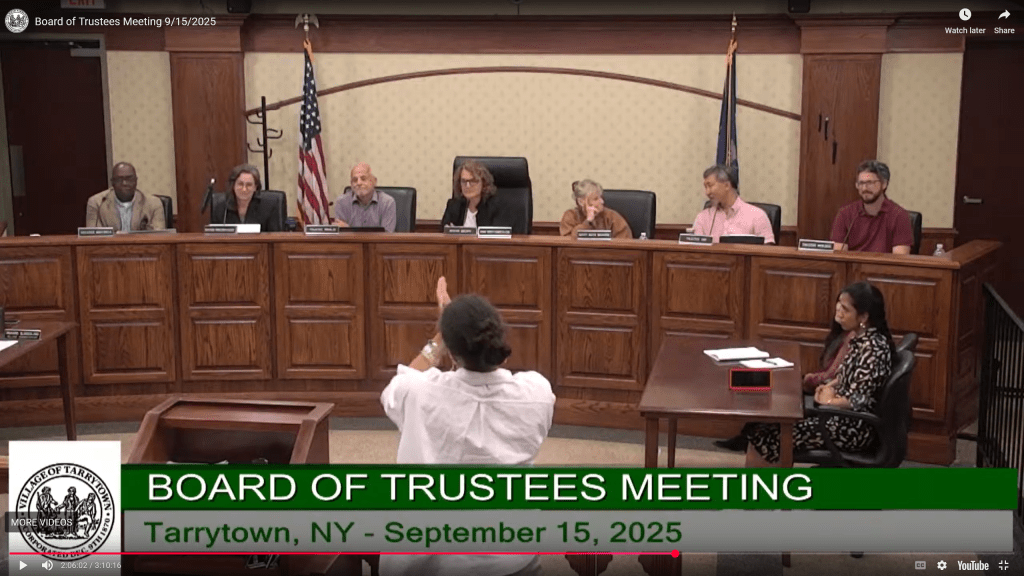
Attendees of the meeting September 15, 2025 meeting cheered after members of Tarrytown’s Board of Trustees voted to approve the new law.

The Tarrytown community came out in force to support good cause eviction protections—and the advocacy made a difference!

On September 15, 2025, the Tarrytown Board of Trustees voted to opt in to the Good Cause Eviction Law. Under the new law, landlords can’t refuse to renew a tenant’s lease unless they have “good cause” (such as nonpayment of rent or misconduct toward other tenants), and tenants can challenge rent increases that are excessive under the law’s definition.

A Tarrytown tenant has the protection of the new law if:

1) their building isn’t already rent-stabilized or otherwise subject to other laws regulating rent and eviction;

2) their building was built before January 1, 2009;

3) their landlord does not also live in the building–unless the building has more than 10 residential units ; and

4) their landlord owns more than one rental unit in the State of New York.

Livable Tarrytowns congratulates the advocates who have worked so hard to achieve this new protection for about 70% of Tarrytown’s tenants. We also thank the Board of Trustees for taking this important step in support of more affordable housing and better living conditions for renters.

To see Tarrytown’s version of the law that was passed on September 15, go here.

Why Tarrytown Needs a Strong “Good Cause” Eviction Law

Tarrytown’s Board of Trustees will soon vote on whether the Village should opt into New York State’s Good Cause Eviction Law. The law sets fair rules and clear expectations for landlords and tenants alike.  Under the law, landlords must have good cause (e.g., non-payment of rent) to evict someone; it also sets reasonable parameters around the amount of a rent increase at the time of a lease renewal, unless a landlord can demonstrate good cause for exceeding those parameters.

The law has many exemptions. It only applies to buildings built after 2009, for example, and excludes government-regulated buildings, co-ops, and condos. In addition, the law exempts owner-occupied buildings with fewer than 11 rental units and units owned by “small landlords,” a term that individual municipalities can amend to best suit their locality’s needs.

To ensure that Tarrytown’s version of the law is sufficiently strong to protect renters—our neighbors—there are two amendments that are needed. The current draft of the law, which will be up for debate at the public hearing on Monday, Sept. 15 at 7 pm at Village Hall, features those amendments in their strongest form. It is that version of the law that the Board of Trustees ought to pass.

First, the current draft denotes that Tarrytown should increase the rent amount eligible for exemption from the law from 245% of fair market rent (as determined by U.S. Department of Housing & Urban Development) to 345%. The amendment will make it harder for landlords to raise rents to avoid the law; it also reflects the continued disparity between the rising cost of living and stagnant wages.

Second, the current draft defines a “small landlord” as one whose New York State real estate portfolio is comprised of no more than one rental property. There are many reasons for doing so:

1. Lowering the number to one increases the number of renters protected by the law.

2. A lower number makes it more difficult for unscrupulous landlords to falsely claim that “good cause” does not apply to them, and easier for tenants to find out if a landlord exceeds the legal limit. (In theory, the law requires landlords to let a tenant know how many units they own, but there is no mechanism to ensure that landlords are honest. Moreover, many landlords, especially large corporate ones, hide their ownership through LLCs, limited liability corporations. Indeed, some landlords have multiple LLCs, making it very difficult for a tenant to know how many rental properties they actually own. There’s no database that provides such information

3. A growing number of LLCs own property in Tarrytown. LLCs now own more than 17 percent of the parcels in the area bounded by Central Avenue, North Washington, Wildey St, and Mechanics Avenue, for example.

4. The growth corresponds to rising eviction rates in Tarrytown: According to data gathered from the Statewide Landlord Tenant Eviction Dashboard, there was a 1500% increase (from 2 to 32 cases) in eviction filings from 2023 to 2024, in housing court. As of late July, there had already been 38 filings in 2025. Those numbers fail to capture the full reality of housing insecurity as most struggling tenants cannot afford the time or expense to pursue legal remedies in the face of problems with landlords and focus instead on finding new housing for themselves and their families.

5. A lower threshold is a disincentive for corporate property owners aiming to purchase multiple properties. It thus provides more opportunities for small, local property owners, who will be more likely to have fairer and more equitable relationships with their tenants and be more community focused.

A strong Good Cause Eviction law will make Tarrytown more stable, more affordable, and fairer for all!

Please attend the meeting of the Tarrytown Board of Trustees at Village Hall—at 7pm on Mon., September 15, 2025, when Trustees will discuss and possibly vote on the law.

You can also write (via email) to the Trustees to voice your support for the draft law.

If you would like a handout version (81/2″ x 14″) of the above to share with others or to post somewhere, please download the pdf below.

Do you want to help build a nature trail to the Tappan Hill School?

Please consider joining Livable Tarrytowns and the Horseman Parent Teacher Association (PTA) to build a nature trail that will access the Tappan Hill School in Tarrytown. The trail will go from Ichabod Lane (where there is already an accessible entrance) to Rosehill Avenue.

The fun/work will involve picking up trash, clearing brush, and raking the trail. Both young children and older folks are welcome to participate.

The trail-making will take place on two dates: Saturday, May 31, 2025, and Sunday, June 1. On each day, there will be two time slots: 9am – 12pm, and 12pm – 3pm.

If you would like to learn more, or if you simply want to sign up for a particular day and time, please go here (and scroll down to the bottom of the page).

Livable Tarrytowns calls upon Tarrytown’s Board of Trustees to Support “Good Cause Eviction” Law

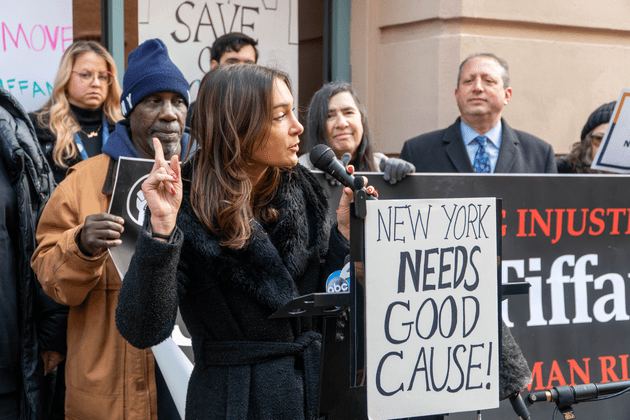
Photo credit: NYS Senate Media Services

This morning (May 19, 2025), Livable Tarrytowns sent a letter (see below) to Mayor Karen Brown and the other members of Tarrytown’s Board of Trustees, urging them to opt into New York State’s Good Cause Eviction Law.

At the Board’s meeting in April, economist Brian Callaci presented on what he sees as the multiple benefits of the law. (Video of that testimony is available here.)

At tonight’s Board meeting, opponents of the law representing the real estate industry and landlords will offer a very different take.

The Board of Trustees is scheduled to vote on the matter at its meeting on June 16, 2025.

Livable Tarrytowns encourages folks to turn out at the June meeting and to call upon Trustees to follow the lead of municipalities such as Beacon, Croton-on-Hudson, and Nyack by opting into the Good Cause Eviction Law.

The Village of Tarrytown needs to act quickly to protect students attending the Tappan Hill School

Starting in September 2025, first-graders of the Public Schools of the Tarrytowns will attend the Tappan Hill School. Kindergartners will follow at a later date.

Tappan Hill School

Located on Ichabod Lane in the Crest neighborhood of Tarrytown, the Tappan Hill School is surrounded by busy commuter thoroughfares (Altamont, Highland, Marymount, Rosehill, and Union Avenues, and Crest Drive). None of these streets have sidewalks or bicycle lanes, making them inhospitable to pedestrians and cyclists.

When the school opens, increased traffic in the neighborhood will make the existing situation even more dangerous.  For this reason and more, concerned parents and Livable Tarrytowns have been in dialogue with officials in the Village of Tarrytown for almost a year to bring about infrastructure changes that will allow for walking and biking safely in the area surrounding the Tappan Hill campus. Thus far, such changes have not happened.

Only a little more than 3 months remain before school opens in the fall. As such, Livable Tarrytowns is pushing the Village of Tarrytown to implement low-cost, interim solutions by the end of August. The goal is to provide an alternative to transportation via school bus or private automobiles (and clogged roads and increased air pollution) for students and their caretakers.

Such a goal is consistent with the school district’s “Student Wellness” policy. The policy calls for, among other things, the promotion of “walking/biking to school (with proper storage of bicycles), safe routes to school, and ‘walking’ school buses.”

In this spirit, Livable Tarrytowns has proposed the implementation of various measures—ones that are within the purview of the Village of Tarrytown.

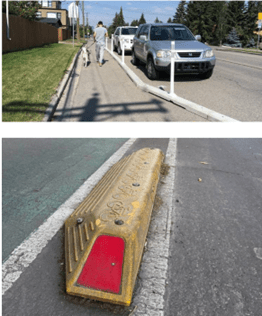
One entails the making of “quick-build” walking lanes by appropriating some of the space now fully dedicated to motor vehicles.  This would involve the installation of concrete or plastic delineators. 

Such changes, by narrowing the roads, would have the added benefit of slowing down drivers. (See image below.) It is well documented that wide roads encourage speeding

There are also things that the Public Schools of the Tarrytowns can do to facilitate safe passage to and from the Tappan Hill School.

Cars parked over the sidewalk at the Tappan Hill School.

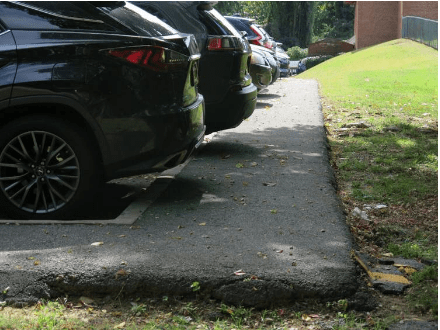
One is to widen the sidewalks on the Tappan Hill campus so that they allow for strollers to pass and comply with the Americans with Disabilities Act. Another is the moving of parking away from the edge of the sidewalk. Currently, vehicles parked on the campus often intrude on the sidewalk, creating a hazard-prone situation.

To bring about such changes, Livable Tarrytowns has called upon Tarrytown’s Board of Trustees to hire a planner to propose low-cost, short-term solutions as well as a long-term transformation of the area around the campus.

What can people do to help?

Please email the members of Tarrytown’s Board of Trustees (see the list of members below) and voice support for walkable schools!

Karen Brown <kBrown@tarrytowngov.com>,

Kenny Herzog <kherzog@tarrytownny.gov>,

David Kim <DKim@tarrytownny.gov>,

Thomas Mitchell <tmitchell@tarrytownny.gov>,

Becky McGovern <bmcgovern@tarrytowngov.com>,

Effie Phillips Staley <EPStaley@tarrytownny.gov>,

Paul Rinaldi <prinaldi@tarrytownny.gov>.

And please look out for future notices from Livable Tarrytowns as our campaign to ensure safe pedestrian passage to and from the Tappan Hill School continues to unfold.

A Wish for the New Year: A Broadway and Franklin St. Area Safe for Schoolchildren

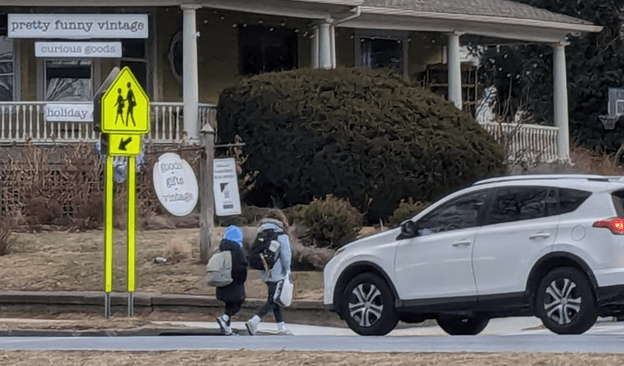
Washington Irving students crossing Broadway at Franklin, January 13, 2025. Photo by Giselle Schuetz.

Livable Tarrytowns has a long list of wishes for 2025. Near the top of that list are far-reaching changes to the Broadway and Franklin Street intersection.

Because it is adjacent to the Washington Irving School, the intersection sees a lot of pedestrian traffic. And because it is poorly designed, the intersection poses a threat to people crossing both Broadway and Franklin Street.

As many parents have informed us, and numerous Livable Tarrytown members themselves have experienced, “near-misses”—when motor vehicles come close to striking a pedestrian—are common. Madeline Praino, a retired, longtime TUFSD teacher, for example, told us about crossing Franklin Street at around 4 pm one fall afternoon in 2023. A vehicle traveling northward on Broadway took a left at Franklin while focusing only on the oncoming traffic on Broadway, not paying any heed to Franklin Street itself. The vehicle almost struck Ms. Praino and her granddaughter. The same thing happened to the pair a second time this past December.

And then there are the “non-misses.”

In 2020, a motor vehicle struck a 4th-grader in the crosswalk, breaking his arm.

Prior to that, between 1987 and 2019, according to the New York State Department of Transportation, the intersection saw 96 vehicle crashes, resulting in 78 “minor” injuries and 4 “serious” ones. Ten of the crashes resulted in minor injuries to people walking.

Despite so many crashes and injuries, there has been no redesign of the intersection, and no implementation of infrastructural changes that compel drivers to proceed with caution.

A recent incident illustrates one reason why crossing Broadway at Franklin can be so dangerous.

On the afternoon of October 2, 2024, children were partaking in after-school play at the Washington Irving campus. During this time, two 9-year-old participants announced that they were going to walk home. Because they had no adults with them and the crossing guard was no longer on duty, a parent who was present, Denis Fogarty, told them that he would help them traverse Broadway.

In an email with DOT officials, Mr. Fogarty explains what happened next as they waited on the sidewalk to cross from the west side to the east side of the thoroughfare. “We made eye contact with the driver heading southbound and the minibus driver headed northbound and both vehicles stopped.  As we walked across the street, I was forced to grab the children and pull them back.  A sedan, which was behind the minibus, could not see why the bus had stopped darted into the crosswalk.  This is possible as Franklin St runs perpendicular east, into Broadway and gives cars the space to make such a maneuver.” (See the illustration below.)

The blue and yellow blocks represent the vehicles that stopped for Mr. Fogarty and the two children. The red block and arrows represent the car that went around the minibus (in yellow) and almost struck them. Illustration by Denis Fogarty.

In response to Mr. Fogarty’s email, Jenny Baez, the NYSDOT Area Construction Supervisor, said that the agency “has no current construction projects scheduled” to reconfigure the intersection. She went on to report that “[a]ny future work by the NYSDOT at the intersection of U.S. Route 9 and Franklin Street would be done as part of the U.S. Route 9 Complete Streets project if determined to be feasible.”

Such work, optimistically speaking, is years down the proverbial road. While the intersection is in the Village of Tarrytown, Broadway is a state thoroughfare and thus any changes to the roadway require approval from the NYSDOT. For the Village to remake the intersection requires permission from New York State authorities.

In recognition of both the dangerous nature of the intersection and the DOT’s responsibility for its design and maintenance, Tarrytown’s Board of Trustees unanimously passed a resolution on November 4. It requests “that the New Yok State Department of Transportation investigate a short-term solution to improve pedestrian safety at the intersection of Franklin Street and Rt. 9/Broadway and provide resources to make this important safety improvement.” Three days after the decree’s passage, the Village sent the resolution, along with a letter, to the DOT.

As of this writing, the DOT has not responded to the Village of Tarrytown.

Still, there are important measures that the Village can implement. Indeed, last week, the Tarrytown Police Department installed mid-road signage similar to what the Village has put into place at Broadway and McKeel. (See image below.)

Broadway at Franklin, looking southward, January 13, 2025. Note the mid-road signage. Photo by David Kim.

What could also prove quite helpful in the immediate term is if the Village were to set out traffic cones on school days to restrict northbound Broadway traffic flow to one lane and thus prevent cars from driving around vehicles properly stopped at the crosswalk. This would entail, relatedly, parking a police vehicle near the middle of Broadway to warn drivers to slow down in the approach to the crosswalk. (See illustration below.)

The blue rectangle represents a parked police vehicle. The red dots represent traffic cones.

Following the implementation of these measures, the Village could commission a redesign of the intersection and then, via the NYTDOT’s highway work permit process, implement that redesign.

Beyond the intersection, Franklin Street itself needs significant work to enhance safety for drivers, passengers, and pedestrians alike. This past October, a collision between a school bus and a car occurred on the street.

Pedestrians, especially those walking on the south side of Franklin, do not feel secure because of the speed at which many vehicles travel and the narrowness of the sidewalk. In addition, regarding the stretch west of the Washington Irving parking lot, the presence of utility poles can make it difficult for people with strollers to use it. Widening the sidewalk is something the Village should explore.

Making the Old Croton Aqueduct Trail Welcoming to Pedestrians and Cyclists

Mayor Brown, Lesley Walter, and Dan Convissor (of Livable Tarrytowns) on the OCA on October 5.

On the morning of Saturday, October 5, 2024, Tarrytown Mayor Karen Brown joined Lesley Walter, President of Friends of The Old Croton Aqueduct, Robert Lee, Assistant Manager of Old Croton Aqueduct State Historic Park, and members of Livable Tarrytowns’ Old Croton Aqueduct (OCA) working group, for a walk along the OCA trail. The trail is important for many reasons. Chief among them is that it is a well-used route for students and their families walking to and from the Washington Irving School and the John Paulding, middle school, and high school campus.

Beginning at East Franklin and Broadway in Tarrytown, the group headed northward to Bedford Road in Sleepy Hollow. Along the way, the group stopped at each street crossing to evaluate it and consider measures to improve pedestrian and bicycle safety. Below we outline Livable Tarrytowns’ suggestions for improvements.

The first stop was Elizabeth Street. The intersection needs three improvements:

  1. ADA conforming curb cuts on both sides of Elizabeth Street;
  2. a painted and raised crosswalk; and 
  3. a “daylighting” of the northside of the crossing area, with a 15-foot clearance on either side.
Elizabeth Street, looking northward to the OCA.

The group then proceeded to Neperan Road, a two-way street that sees a good deal of traffic. Of particular concern is the high speed at which many vehicles come down the hill as they head toward Broadway. This is concerning not only for people traveling along the OCA trail, but also individuals coming to and from nearby Neperan Park, many of whom cross Neperan Road. As such, a broader set of interventions are needed. They include:

  1. a 3-way stop sign at Altamont and Neperan to force vehicles to slow down at what is a blind curve;
  2. a painted crosswalk that connects the curb cut at Altamont and Neperan to the entrance at Neperan Park;
  3. the installation of an ADA curb ramp at the access point of Neperan Park;
  4. a painted crosswalk with signage on Neperhan at Grove Street;
  5. a painted crosswalk with signage at the OCA crossing and a curb extension or bump out on the north side; and 
  6. the removal of the two parking spots immediately adjacent to the OCA trail entrance on the north side of Neperan.

Hamilton Place was the next stop. Participants in the group identified three measures that are needed:

  1. a painted crosswalk, along with signage, connecting the two sides of the OCA trail at Hamilton; 
  2. an ADA-conforming curb cut on the southside of Hamilton; and
  3. the prohibition of parking on the southside of Hamilton within 15 feet of the OCA trail (see the red vehicle in the photo below). 
Hamilton Place, looking southward.

After Hamilton Place, the group continued northward to McKeel Avenue, a street of major concern for area residents. It was near the OCA crossing where a vehicle struck and killed Mr. Anthony Napoli on August 4, 2022. A crosswalk, signage, and ADA curb cuts are already in place on McKeel (see photo below). Nonetheless, further improvements are needed–not least because of the width of the road and the fact that pedestrians must cross two lanes of traffic. Given these factors, curb extensions or bump outs are needed on either side of the crosswalk. Also necessary are measures to slow down vehicular traffic, particularly at times when the sun makes it difficult for drivers to see the road. Possible measures include: a narrowing of the road, chicanes, and/or speed bumps.

McKeel Avenue at the OCA.

Cobb Lane, a very steep and narrow street, was the next stop. Despite many pedestrians using the street to access the OCA, the various schools on the TUFSD campus, Patriots Park, and other points on Broadway, there is no sidewalk or barrier to protect them. Here are two changes that could improve matters:

  1. the painting of a 5-foot wide “sidewalk” (with some sort of raised edge) along the north side of Cobb Lane from the OCA to Broadway; and
  2. making Cobb Lane from the OCA to Broadway a one-way street.
Cobb Lane at the OCA, looking toward Broadway.

Finally, the group went through the campus of Sleepy Hollow Middle School and Sleepy Hollow High School. Because part of the school building sits atop the actual aqueduct, the trail goes around the east side of the building. Then, north of the building, because several property owners on Hudson Terrace have blocked the OCA’s right of way up to Bedford Road (Route 448), trail users must travel through a parking lot. Resolving these difficulties requires short term and long term steps.

Short term:
  1. Wayfinding signs at appropriate locations on the school campus;
  2. a dedicated walkway on the east side of high school parking lot adjacent to the baseball and softball fields;
  3. unlocking the  gate at Bedford Road on the east side of parking lot to allow walkers and bikers to access the trail system connecting the OCA and Tarrytown Lakes;
  4. an adjustment of the driveway gate so there is a five-foot-wide passage for bikes, adaptive bikes, and wheelchairs; and
The current driveway gate, as seen above, does not allow for passage of bicycles and wheelchairs.

5. the relocation of the map sign from the school side of Bedford Road (see photo below) to the trail side.

Currently, there is no map on the north side of Bedford Road to indicate to people heading southward where to go to continue on the OCA trail.
Long term:
  1. A raised crosswalk on Bedford Road, with signage, at the north end of the high school parking lot; and
  2. reclamation of the OCA property behind Hudson Terrace.

Livable Tarrytowns will push for these changes and more by working with officials in both Sleepy Hollow and Tarrytown as well as with the Public Schools of the Tarrytowns. If you have suggestions for additional improvements, please reach out!

Walking on the OCA trail on October 5, 2024.