A Wish for the New Year: A Broadway and Franklin St. Area Safe for Schoolchildren

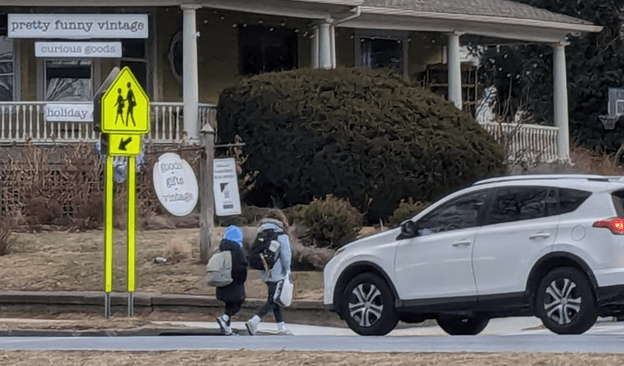
Washington Irving students crossing Broadway at Franklin, January 13, 2025. Photo by Giselle Schuetz.

Livable Tarrytowns has a long list of wishes for 2025. Near the top of that list are far-reaching changes to the Broadway and Franklin Street intersection.

Because it is adjacent to the Washington Irving School, the intersection sees a lot of pedestrian traffic. And because it is poorly designed, the intersection poses a threat to people crossing both Broadway and Franklin Street.

As many parents have informed us, and numerous Livable Tarrytown members themselves have experienced, “near-misses”—when motor vehicles come close to striking a pedestrian—are common. Madeline Praino, a retired, longtime TUFSD teacher, for example, told us about crossing Franklin Street at around 4 pm one fall afternoon in 2023. A vehicle traveling northward on Broadway took a left at Franklin while focusing only on the oncoming traffic on Broadway, not paying any heed to Franklin Street itself. The vehicle almost struck Ms. Praino and her granddaughter. The same thing happened to the pair a second time this past December.

And then there are the “non-misses.”

In 2020, a motor vehicle struck a 4th-grader in the crosswalk, breaking his arm.

Prior to that, between 1987 and 2019, according to the New York State Department of Transportation, the intersection saw 96 vehicle crashes, resulting in 78 “minor” injuries and 4 “serious” ones. Ten of the crashes resulted in minor injuries to people walking.

Despite so many crashes and injuries, there has been no redesign of the intersection, and no implementation of infrastructural changes that compel drivers to proceed with caution.

A recent incident illustrates one reason why crossing Broadway at Franklin can be so dangerous.

On the afternoon of October 2, 2024, children were partaking in after-school play at the Washington Irving campus. During this time, two 9-year-old participants announced that they were going to walk home. Because they had no adults with them and the crossing guard was no longer on duty, a parent who was present, Denis Fogarty, told them that he would help them traverse Broadway.

In an email with DOT officials, Mr. Fogarty explains what happened next as they waited on the sidewalk to cross from the west side to the east side of the thoroughfare. “We made eye contact with the driver heading southbound and the minibus driver headed northbound and both vehicles stopped.  As we walked across the street, I was forced to grab the children and pull them back.  A sedan, which was behind the minibus, could not see why the bus had stopped darted into the crosswalk.  This is possible as Franklin St runs perpendicular east, into Broadway and gives cars the space to make such a maneuver.” (See the illustration below.)

The blue and yellow blocks represent the vehicles that stopped for Mr. Fogarty and the two children. The red block and arrows represent the car that went around the minibus (in yellow) and almost struck them. Illustration by Denis Fogarty.

In response to Mr. Fogarty’s email, Jenny Baez, the NYSDOT Area Construction Supervisor, said that the agency “has no current construction projects scheduled” to reconfigure the intersection. She went on to report that “[a]ny future work by the NYSDOT at the intersection of U.S. Route 9 and Franklin Street would be done as part of the U.S. Route 9 Complete Streets project if determined to be feasible.”

Such work, optimistically speaking, is years down the proverbial road. While the intersection is in the Village of Tarrytown, Broadway is a state thoroughfare and thus any changes to the roadway require approval from the NYSDOT. For the Village to remake the intersection requires permission from New York State authorities.

In recognition of both the dangerous nature of the intersection and the DOT’s responsibility for its design and maintenance, Tarrytown’s Board of Trustees unanimously passed a resolution on November 4. It requests “that the New Yok State Department of Transportation investigate a short-term solution to improve pedestrian safety at the intersection of Franklin Street and Rt. 9/Broadway and provide resources to make this important safety improvement.” Three days after the decree’s passage, the Village sent the resolution, along with a letter, to the DOT.

As of this writing, the DOT has not responded to the Village of Tarrytown.

Still, there are important measures that the Village can implement. Indeed, last week, the Tarrytown Police Department installed mid-road signage similar to what the Village has put into place at Broadway and McKeel. (See image below.)

Broadway at Franklin, looking southward, January 13, 2025. Note the mid-road signage. Photo by David Kim.

What could also prove quite helpful in the immediate term is if the Village were to set out traffic cones on school days to restrict northbound Broadway traffic flow to one lane and thus prevent cars from driving around vehicles properly stopped at the crosswalk. This would entail, relatedly, parking a police vehicle near the middle of Broadway to warn drivers to slow down in the approach to the crosswalk. (See illustration below.)

The blue rectangle represents a parked police vehicle. The red dots represent traffic cones.

Following the implementation of these measures, the Village could commission a redesign of the intersection and then, via the NYTDOT’s highway work permit process, implement that redesign.

Beyond the intersection, Franklin Street itself needs significant work to enhance safety for drivers, passengers, and pedestrians alike. This past October, a collision between a school bus and a car occurred on the street.

Pedestrians, especially those walking on the south side of Franklin, do not feel secure because of the speed at which many vehicles travel and the narrowness of the sidewalk. In addition, regarding the stretch west of the Washington Irving parking lot, the presence of utility poles can make it difficult for people with strollers to use it. Widening the sidewalk is something the Village should explore.

Making the Old Croton Aqueduct Trail Welcoming to Pedestrians and Cyclists

Mayor Brown, Lesley Walter, and Dan Convissor (of Livable Tarrytowns) on the OCA on October 5.

On the morning of Saturday, October 5, 2024, Tarrytown Mayor Karen Brown joined Lesley Walter, President of Friends of The Old Croton Aqueduct, Robert Lee, Assistant Manager of Old Croton Aqueduct State Historic Park, and members of Livable Tarrytowns’ Old Croton Aqueduct (OCA) working group, for a walk along the OCA trail. The trail is important for many reasons. Chief among them is that it is a well-used route for students and their families walking to and from the Washington Irving School and the John Paulding, middle school, and high school campus.

Beginning at East Franklin and Broadway in Tarrytown, the group headed northward to Bedford Road in Sleepy Hollow. Along the way, the group stopped at each street crossing to evaluate it and consider measures to improve pedestrian and bicycle safety. Below we outline Livable Tarrytowns’ suggestions for improvements.

The first stop was Elizabeth Street. The intersection needs three improvements:

  1. ADA conforming curb cuts on both sides of Elizabeth Street;
  2. a painted and raised crosswalk; and 
  3. a “daylighting” of the northside of the crossing area, with a 15-foot clearance on either side.
Elizabeth Street, looking northward to the OCA.

The group then proceeded to Neperan Road, a two-way street that sees a good deal of traffic. Of particular concern is the high speed at which many vehicles come down the hill as they head toward Broadway. This is concerning not only for people traveling along the OCA trail, but also individuals coming to and from nearby Neperan Park, many of whom cross Neperan Road. As such, a broader set of interventions are needed. They include:

  1. a 3-way stop sign at Altamont and Neperan to force vehicles to slow down at what is a blind curve;
  2. a painted crosswalk that connects the curb cut at Altamont and Neperan to the entrance at Neperan Park;
  3. the installation of an ADA curb ramp at the access point of Neperan Park;
  4. a painted crosswalk with signage on Neperhan at Grove Street;
  5. a painted crosswalk with signage at the OCA crossing and a curb extension or bump out on the north side; and 
  6. the removal of the two parking spots immediately adjacent to the OCA trail entrance on the north side of Neperan.

Hamilton Place was the next stop. Participants in the group identified three measures that are needed:

  1. a painted crosswalk, along with signage, connecting the two sides of the OCA trail at Hamilton; 
  2. an ADA-conforming curb cut on the southside of Hamilton; and
  3. the prohibition of parking on the southside of Hamilton within 15 feet of the OCA trail (see the red vehicle in the photo below). 
Hamilton Place, looking southward.

After Hamilton Place, the group continued northward to McKeel Avenue, a street of major concern for area residents. It was near the OCA crossing where a vehicle struck and killed Mr. Anthony Napoli on August 4, 2022. A crosswalk, signage, and ADA curb cuts are already in place on McKeel (see photo below). Nonetheless, further improvements are needed–not least because of the width of the road and the fact that pedestrians must cross two lanes of traffic. Given these factors, curb extensions or bump outs are needed on either side of the crosswalk. Also necessary are measures to slow down vehicular traffic, particularly at times when the sun makes it difficult for drivers to see the road. Possible measures include: a narrowing of the road, chicanes, and/or speed bumps.

McKeel Avenue at the OCA.

Cobb Lane, a very steep and narrow street, was the next stop. Despite many pedestrians using the street to access the OCA, the various schools on the TUFSD campus, Patriots Park, and other points on Broadway, there is no sidewalk or barrier to protect them. Here are two changes that could improve matters:

  1. the painting of a 5-foot wide “sidewalk” (with some sort of raised edge) along the north side of Cobb Lane from the OCA to Broadway; and
  2. making Cobb Lane from the OCA to Broadway a one-way street.
Cobb Lane at the OCA, looking toward Broadway.

Finally, the group went through the campus of Sleepy Hollow Middle School and Sleepy Hollow High School. Because part of the school building sits atop the actual aqueduct, the trail goes around the east side of the building. Then, north of the building, because several property owners on Hudson Terrace have blocked the OCA’s right of way up to Bedford Road (Route 448), trail users must travel through a parking lot. Resolving these difficulties requires short term and long term steps.

Short term:
  1. Wayfinding signs at appropriate locations on the school campus;
  2. a dedicated walkway on the east side of high school parking lot adjacent to the baseball and softball fields;
  3. unlocking the  gate at Bedford Road on the east side of parking lot to allow walkers and bikers to access the trail system connecting the OCA and Tarrytown Lakes;
  4. an adjustment of the driveway gate so there is a five-foot-wide passage for bikes, adaptive bikes, and wheelchairs; and
The current driveway gate, as seen above, does not allow for passage of bicycles and wheelchairs.

5. the relocation of the map sign from the school side of Bedford Road (see photo below) to the trail side.

Currently, there is no map on the north side of Bedford Road to indicate to people heading southward where to go to continue on the OCA trail.
Long term:
  1. A raised crosswalk on Bedford Road, with signage, at the north end of the high school parking lot; and
  2. reclamation of the OCA property behind Hudson Terrace.

Livable Tarrytowns will push for these changes and more by working with officials in both Sleepy Hollow and Tarrytown as well as with the Public Schools of the Tarrytowns. If you have suggestions for additional improvements, please reach out!

Walking on the OCA trail on October 5, 2024.