Making the Old Croton Aqueduct Trail Welcoming to Pedestrians and Cyclists

Mayor Brown, Lesley Walter, and Dan Convissor (of Livable Tarrytowns) on the OCA on October 5.

On the morning of Saturday, October 5, 2024, Tarrytown Mayor Karen Brown joined Lesley Walter, President of Friends of The Old Croton Aqueduct, Robert Lee, Assistant Manager of Old Croton Aqueduct State Historic Park, and members of Livable Tarrytowns’ Old Croton Aqueduct (OCA) working group, for a walk along the OCA trail. The trail is important for many reasons. Chief among them is that it is a well-used route for students and their families walking to and from the Washington Irving School and the John Paulding, middle school, and high school campus.

Beginning at East Franklin and Broadway in Tarrytown, the group headed northward to Bedford Road in Sleepy Hollow. Along the way, the group stopped at each street crossing to evaluate it and consider measures to improve pedestrian and bicycle safety. Below we outline Livable Tarrytowns’ suggestions for improvements.

The first stop was Elizabeth Street. The intersection needs three improvements:

  1. ADA conforming curb cuts on both sides of Elizabeth Street;
  2. a painted and raised crosswalk; and 
  3. a “daylighting” of the northside of the crossing area, with a 15-foot clearance on either side.
Elizabeth Street, looking northward to the OCA.

The group then proceeded to Neperan Road, a two-way street that sees a good deal of traffic. Of particular concern is the high speed at which many vehicles come down the hill as they head toward Broadway. This is concerning not only for people traveling along the OCA trail, but also individuals coming to and from nearby Neperan Park, many of whom cross Neperan Road. As such, a broader set of interventions are needed. They include:

  1. a 3-way stop sign at Altamont and Neperan to force vehicles to slow down at what is a blind curve;
  2. a painted crosswalk that connects the curb cut at Altamont and Neperan to the entrance at Neperan Park;
  3. the installation of an ADA curb ramp at the access point of Neperan Park;
  4. a painted crosswalk with signage on Neperhan at Grove Street;
  5. a painted crosswalk with signage at the OCA crossing and a curb extension or bump out on the north side; and 
  6. the removal of the two parking spots immediately adjacent to the OCA trail entrance on the north side of Neperan.

Hamilton Place was the next stop. Participants in the group identified three measures that are needed:

  1. a painted crosswalk, along with signage, connecting the two sides of the OCA trail at Hamilton; 
  2. an ADA-conforming curb cut on the southside of Hamilton; and
  3. the prohibition of parking on the southside of Hamilton within 15 feet of the OCA trail (see the red vehicle in the photo below). 
Hamilton Place, looking southward.

After Hamilton Place, the group continued northward to McKeel Avenue, a street of major concern for area residents. It was near the OCA crossing where a vehicle struck and killed Mr. Anthony Napoli on August 4, 2022. A crosswalk, signage, and ADA curb cuts are already in place on McKeel (see photo below). Nonetheless, further improvements are needed–not least because of the width of the road and the fact that pedestrians must cross two lanes of traffic. Given these factors, curb extensions or bump outs are needed on either side of the crosswalk. Also necessary are measures to slow down vehicular traffic, particularly at times when the sun makes it difficult for drivers to see the road. Possible measures include: a narrowing of the road, chicanes, and/or speed bumps.

McKeel Avenue at the OCA.

Cobb Lane, a very steep and narrow street, was the next stop. Despite many pedestrians using the street to access the OCA, the various schools on the TUFSD campus, Patriots Park, and other points on Broadway, there is no sidewalk or barrier to protect them. Here are two changes that could improve matters:

  1. the painting of a 5-foot wide “sidewalk” (with some sort of raised edge) along the north side of Cobb Lane from the OCA to Broadway; and
  2. making Cobb Lane from the OCA to Broadway a one-way street.
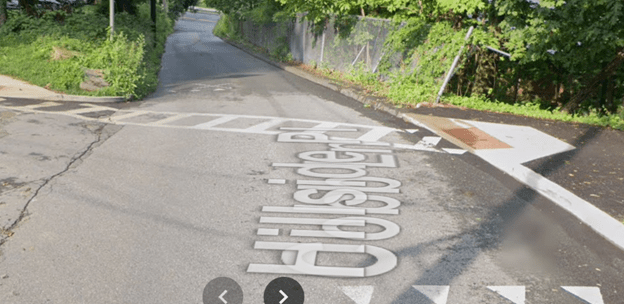
Cobb Lane at the OCA, looking toward Broadway.

Finally, the group went through the campus of Sleepy Hollow Middle School and Sleepy Hollow High School. Because part of the school building sits atop the actual aqueduct, the trail goes around the east side of the building. Then, north of the building, because several property owners on Hudson Terrace have blocked the OCA’s right of way up to Bedford Road (Route 448), trail users must travel through a parking lot. Resolving these difficulties requires short term and long term steps.

Short term:
  1. Wayfinding signs at appropriate locations on the school campus;
  2. a dedicated walkway on the east side of high school parking lot adjacent to the baseball and softball fields;
  3. unlocking the  gate at Bedford Road on the east side of parking lot to allow walkers and bikers to access the trail system connecting the OCA and Tarrytown Lakes;
  4. an adjustment of the driveway gate so there is a five-foot-wide passage for bikes, adaptive bikes, and wheelchairs; and
The current driveway gate, as seen above, does not allow for passage of bicycles and wheelchairs.

5. the relocation of the map sign from the school side of Bedford Road (see photo below) to the trail side.
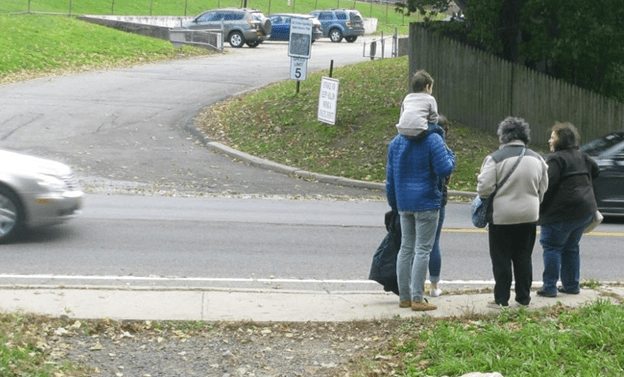
Currently, there is no map on the north side of Bedford Road to indicate to people heading southward where to go to continue on the OCA trail.
Long term:
  1. A raised crosswalk on Bedford Road, with signage, at the north end of the high school parking lot; and
  2. reclamation of the OCA property behind Hudson Terrace.

Livable Tarrytowns will push for these changes and more by working with officials in both Sleepy Hollow and Tarrytown as well as with the Public Schools of the Tarrytowns. If you have suggestions for additional improvements, please reach out!

Walking on the OCA trail on October 5, 2024.

Recent Victories to Celebrate, More Work to Do!

Blocked crosswalks on Main Street and John Street, Tarrytown, June 20, 2024.

Scenes such as this recent one showing vehicles parked in crosswalks in downtown Tarrytown threaten pedestrians. Frustrating and all too common, they serve to remind us of one of the many reasons the work of Livable Tarrytowns is so necessary.

But we also need to remember and celebrate what we (along with our allies) have accomplished in the last few months—not least to sustain ourselves!

On May 29, the Sleepy Hollow Board of Trustees approved a “Sustainable Complete Streets Policy” that contains clear benchmarks that the Village needs to achieve each year. Originally drafted by Sustainable Sleepy Hollow, the policy requires the Village to “carry out a system of implementation, to include surveying roadways and intersections, identifying opportunities for improvements, ranking streets and roadways identified for enhancements, installing pilot or demonstration projects, evaluating performance of the pilot or demonstration projects, and permanently installing these projects.”

Different projects have distinct point values assigned to them. Installing a marked crosswalk with signage or putting in a speed hump, for example, is worth two points, while a roundabout (a major undertaking) is worth twenty. New sidewalk planters or planters at curb extensions get one point, while the installation of bioswales or raingardens at tree pits within curb extensions receive seven points. The Village must attain a minimum of 25 points annually.

And Sleepy Hollow is already making progress.

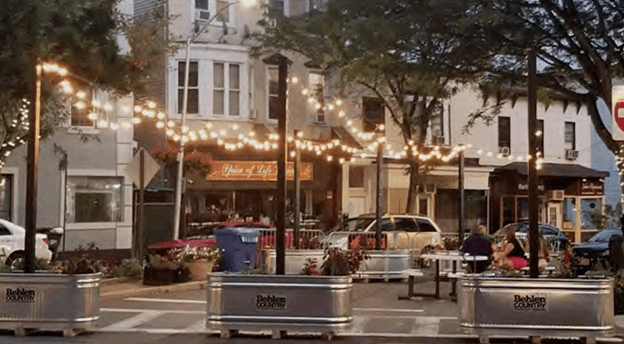
Pedestrian plaza, looking southward from Beekman Avenue at Cortlandt Street.
Credit: Village of Sleepy Hollow.

Currently, the Sleepy Hollow Board of Trustees is conducting an analysis of the temporary and highly successful pedestrian plaza on Cortlandt Street at Beekman Avenue with an eye toward improving it and making it permanent. The Village has grant money that it has won and will apply to the plaza.

In addition, in response to emails and letters from residents and parents of schoolchildren, the Village has painted curb extensions (or “bump-outs”) around crosswalks on Beekman Avenue and Pocantico Street. Soon—to prevent scenes such as the one shown above in Tarrytown—the Village of Sleepy Hollow will install physical barriers to deter vehicles from parking in the bump-out areas.

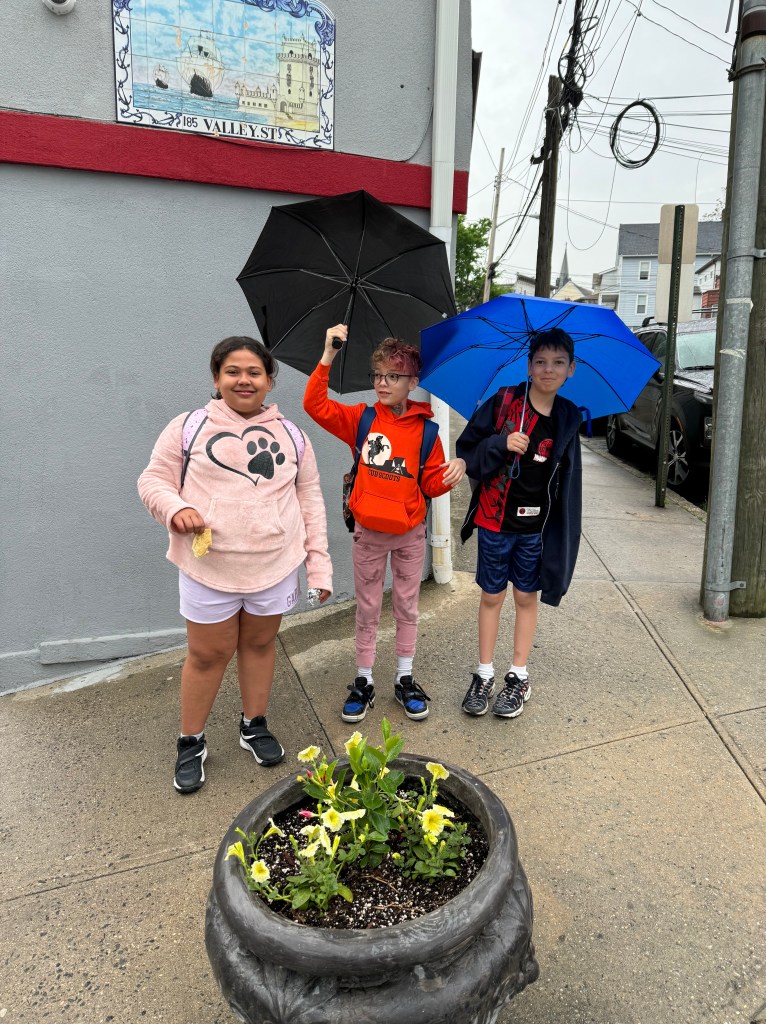
School walkers at Valley Street, May 8, 2024.

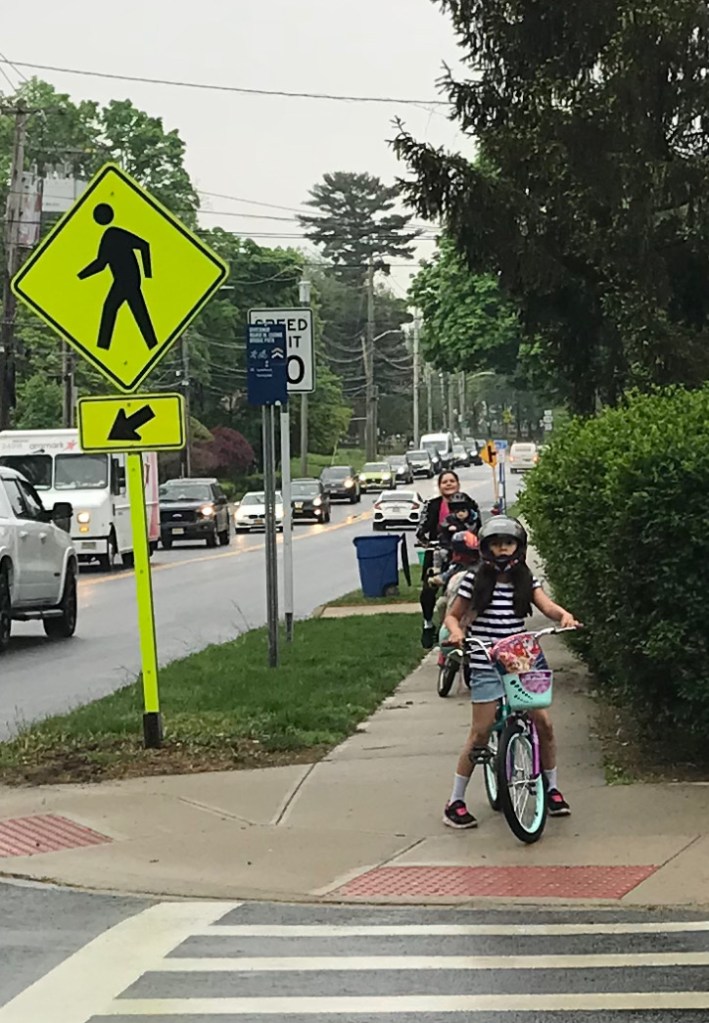
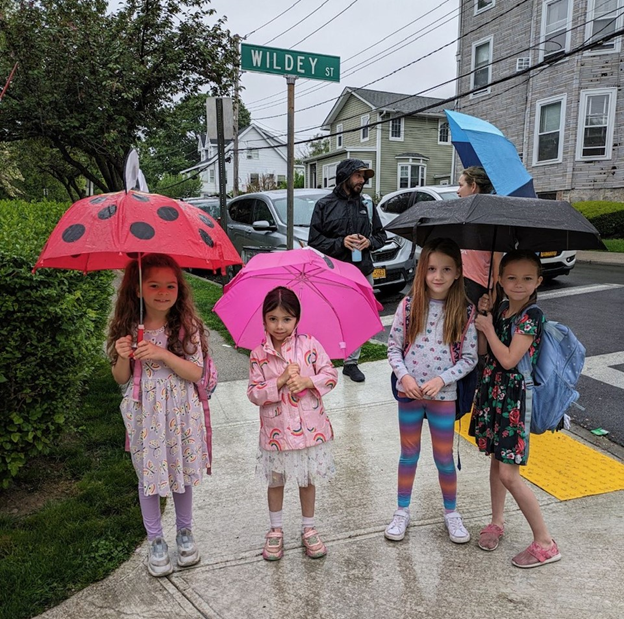
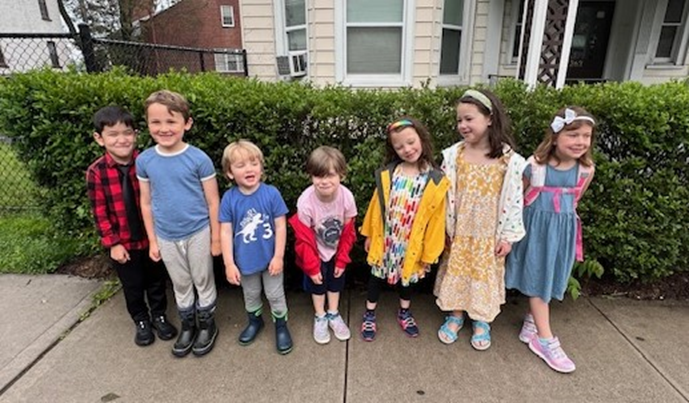
The redesign of the crosswalks near the Morse School comes on the heels of a highly successful Walk/Bike to School Day on May 8—this despite it being a rainy day. Organized by Livable Tarrytowns, the event saw scores of children walking and biking in groups, along with parents and members of the board of trustees from both villages, to the elementary schools. (We are planning another walk and bike day for October 9. Dr. Raymond Sanchez, TUFSD superintendent, will be among the participants!).

Biking on Broadway to the Morse School. (More photos below.)

Also in relation to the TUFSD, the New York State Department of Transportation (DOT) has agreed to make a positive change in proximity of the high school/middle school/John Paulding campus. In a May 6, 2024, letter to the Village of Sleepy Hollow, the DOT approved a “School Safety Zone” and a lowering of the speed limit to 20 miles per hour on Bedford Road (Route 448) between Webber Avenue and Broadway (Route 9).

In the same letter, the DOT approved a speed limit reduction to 25 miles per on Broadway from Bedford Road to College Avenue, but refused to lower it to 20 miles under the dubious logic that there is a signalized crosswalk at Depeyster (and Broadway). Overcoming the DOT’s obstinance to the extension of the “School Safety Zone” along Broadway requires that the New York State legislature pass a “home rule resolution.” Livable Tarrytowns will work with allies to bring about the passage of such a resolution in the next legislative session (which begins in January 2025).

Finally, in mid-May, Livable Tarrytowns submitted a letter to the DOT signed by more than 240 residents of Sleepy Hollow and Tarrytown. The letter called upon the agency to install a median refuge on Broadway at McKeel along with bump-outs at the crosswalks. At the urging of members of Livable Tarrytowns, the Board of Trustees of Tarrytown passed a strong resolution in support.

On June 13, the DOT responded by letter to Livable Tarrytowns. The good news is that the DOT intends to narrow the intersection by pushing the curb on the west side of Broadway into the intersection. On the east side of Broadway at McKeel, the DOT is currently planning to install “bump out” extensions at the crosswalks. Unfortunately, however, the DOT has decided against installing a median refuge.

That said, the letter noted, “The Route 9 Complete Street Project, currently in the preliminary design phase, is evaluating the entire corridor through Tarrytown to determine if median refuge islands are appropriate and feasible.” In other words, more far-reaching changes are under consideration.

Sleepy Hollow Manor bikers outside the Morse School.
Walkers from the Crest in Tarrytown to the Washington Irving and the Morse schools.
Walkers at Wildey Street and North Washington.
Webber Park (Sleepy Hollow) walkers to the John Paulding.
Walkers on Main Street heading to the John Paulding and Morse schools.