
A recent four-week span has tragically exposed, yet again, how dangerous Broadway is for pedestrians in Sleepy Hollow-Tarrytown. It also painfully highlights the urgency of transforming the principal thoroughfare that joins the twin villages for the well-being of our families, friends, and neighbors.

On the evening of Wednesday, November 29, 2023, two drivers and their vehicles struck Nelida Distante as she crossed Broadway at McKeel Avenue, taking the life of the 82-year-old Tarrytown resident.
Less than one month later, on Tuesday, December 26, at a little before 2 p.m., a driver hit and killed Patrick Kennedy, 79, also of Tarrytown, while he crossed Broadway at Route 119.
In both instances, the victims were in marked crosswalks when they were struck.
The untimely deaths have renewed and intensified efforts to make Broadway safe for all—pedestrians, bicyclists and drivers.
Concerned residents, many of them involved with Livable Tarrytowns and Bike Tarrytown, met twice in December. They brainstormed and discussed changes that they would like to see to the design of what Anne White, co-head of Sustainable Sleepy Hollow and a meeting participant, has referred to as the “Main Street” of the two villages. The initial focus has been on the area of Broadway and McKeel given that it has been the site of two vehicle-induced fatalities of pedestrians since August 2022. (On August 4, 2022, a driver and his pickup truck killed Mr. Anthony Napoli, 70, on McKeel, between the Croton Aqueduct and Broadway.)
Out of work already done in relation to the Route 9 Active Transportation Project, ideas generated by the discussions, and the design efforts of Bike Tarrytown, two proposals have emerged for what a “good” Broadway and McKeel would look like.

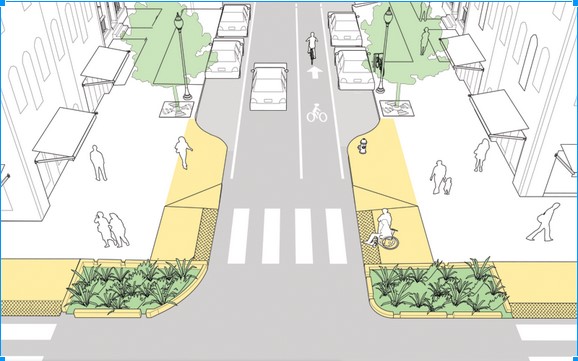
The first proposal (above) is for a pilot project to address safety issues in the short term. It would entail the creation of medians (indicated in purple) in the middle of Broadway via temporary barriers so that pedestrians have a refuge and that they don’t have to cross multiple lanes of traffic. It would also include curb extensions that lessen the distance that pedestrians must traverse in crossing a street. These modifications would have the added benefit of “daylighting” the crosswalks (with two crosswalks added at Dixon Street), thus enhancing pedestrian visibility and welfare.
McKeel Avenue itself would also see changes in the form of a median refuge and a narrowing of the road in proximity to Broadway. The redesign would increase the likelihood that drivers travel at safe speeds. Had these alterations been implemented prior to August 2022, they might very well have saved Mr. Napoli’s life.
The second proposal is for a “permanent” or long-term transformation. As illustrated by the drawing below, the changes would include raising the intersection—from Dixon Street to McKeel Avenue—along Broadway and elevating the crosswalk that traverses McKeel as well. It would also involve installing a two-way, protected bicycle track along the east side of Broadway.
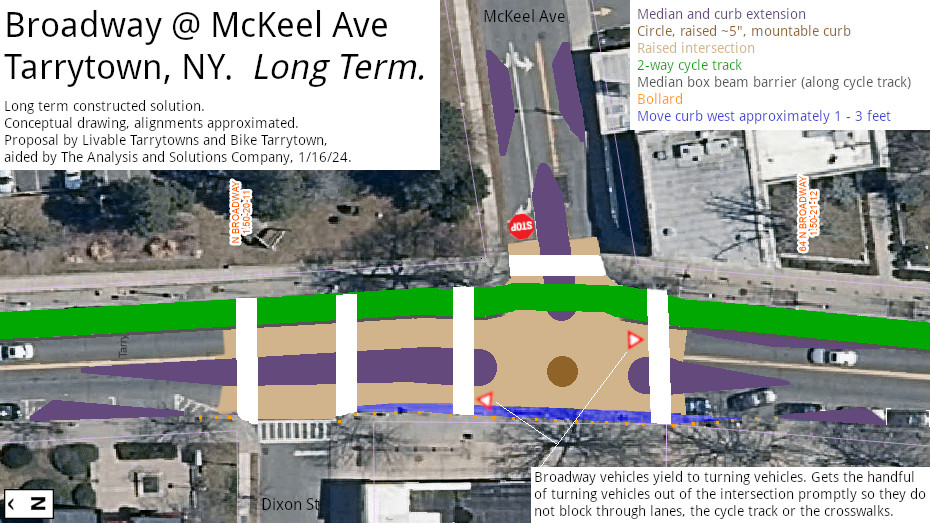
In regard to the proposed changes on McKeel Avenue, the Village of Tarrytown has full authority to make them as it controls the road. Making changes on Broadway, however, is a different matter as the New York State Department of Transportation (NYSDOT) is in charge of the thoroughfare.
If past practice is any indication, it is doubtful that New York’s DOT will be keen on changes to Broadway anywhere near as ambitious as the ones proposed above. The state agency has long been resistant to adopting “best practices” for pedestrian safety in a broad sense, focusing instead on maximizing the efficiency of vehicular traffic flow. However, the DOT has been in conversation in recent weeks with the Village of Tarrytown regarding safety and the Broadway-McKeel Avenue intersection. At the same time, the DOT has been demonstrating of late an openness to engaging constructively in the redesign of Broadway from Hastings to Sleepy Hollow through its participation in the Route 9 Complete Street Preliminary Engineering project. As such, there are openings for pushing for far-reaching changes.

Still, bringing about “A Broadway for All” will undoubtedly require significant pressure from elected officials in both Sleepy Hollow and Tarrytown and residents of the two villages to push the DOT to adopt the types of changes embodied in the drawings above. These changes, inspired by “best practices” in many European countries (see, for example, here), reflect a concern for the well-being of all who use Broadway.
In response to our proposals, some will likely stress the need to be “realistic” in terms of advocating changes to Broadway and McKeel (and the Broadway corridor as a whole). What took place along Broadway between November 29 and December 26, however, demonstrates the need to move beyond the boundaries of what passes for pragmatism, to “think big”–and act accordingly. In other words, we need to create a new reality.
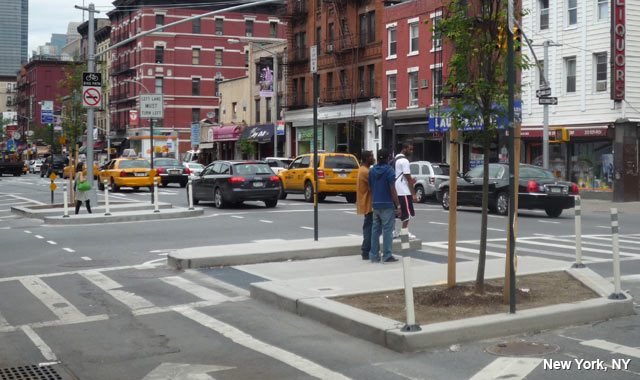
That other countries —and some U.S. municipalities as well–have adopted changes such as the ones we are suggesting here shows what is possible. Only by making far-reaching changes can we make scenes like the one below a remnant of an ugly past rather than painful evidence of an unacceptable present.

 Livable Tarrytowns